
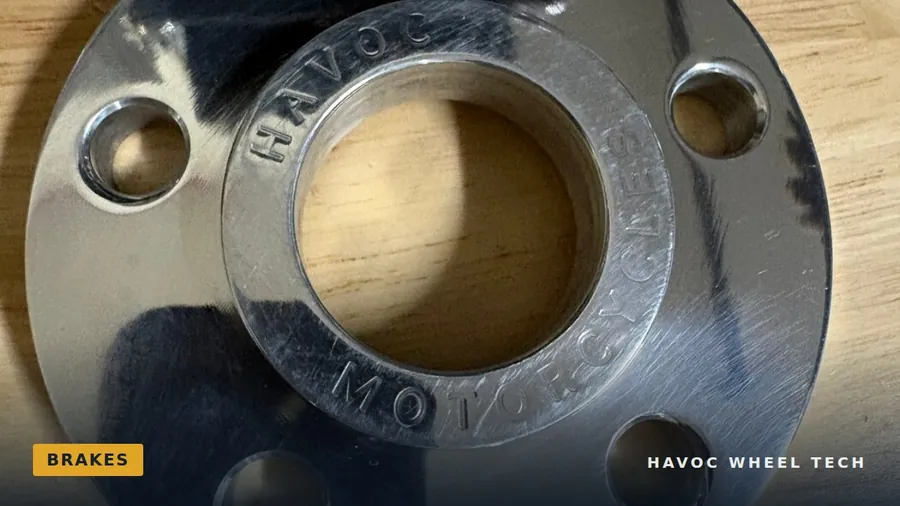
Of all the questions we get after a wheel installation, one of the most common is some version of this: "The new wheel is on, but the brakes drag," or "the bike pulls to one side under braking," or "I can hear the rotor rubbing." In nearly every case, the wheel and rotors are fine. The problem is that the brake calipers were not re-centered over the new rotors.
Why calipers need attention
A motorcycle brake caliper straddles the rotor, with a pad on each side. For the brake to work properly, the rotor has to run in the center of the caliper, with equal clearance to the inside pad and the outside pad. When that is the case, the pads contact the rotor evenly, the caliper pistons share the load, and the rotor spins freely when the brake is released.
Where the rotor ends up relative to the caliper is set by a chain of machined parts: the fork leg or swingarm mounting, the axle spacers, the wheel bearings, the width of the hub, the thickness of the rotor mounting boss, the rotor itself and the caliper body. Every one of those parts is made to a tolerance. Machined parts — wheel hubs, rotors and calipers — can vary in thickness by a few thousandths of an inch. Individually, that is nothing. Stacked together, those small variations can move the rotor far enough off-center to affect how the pads make contact.
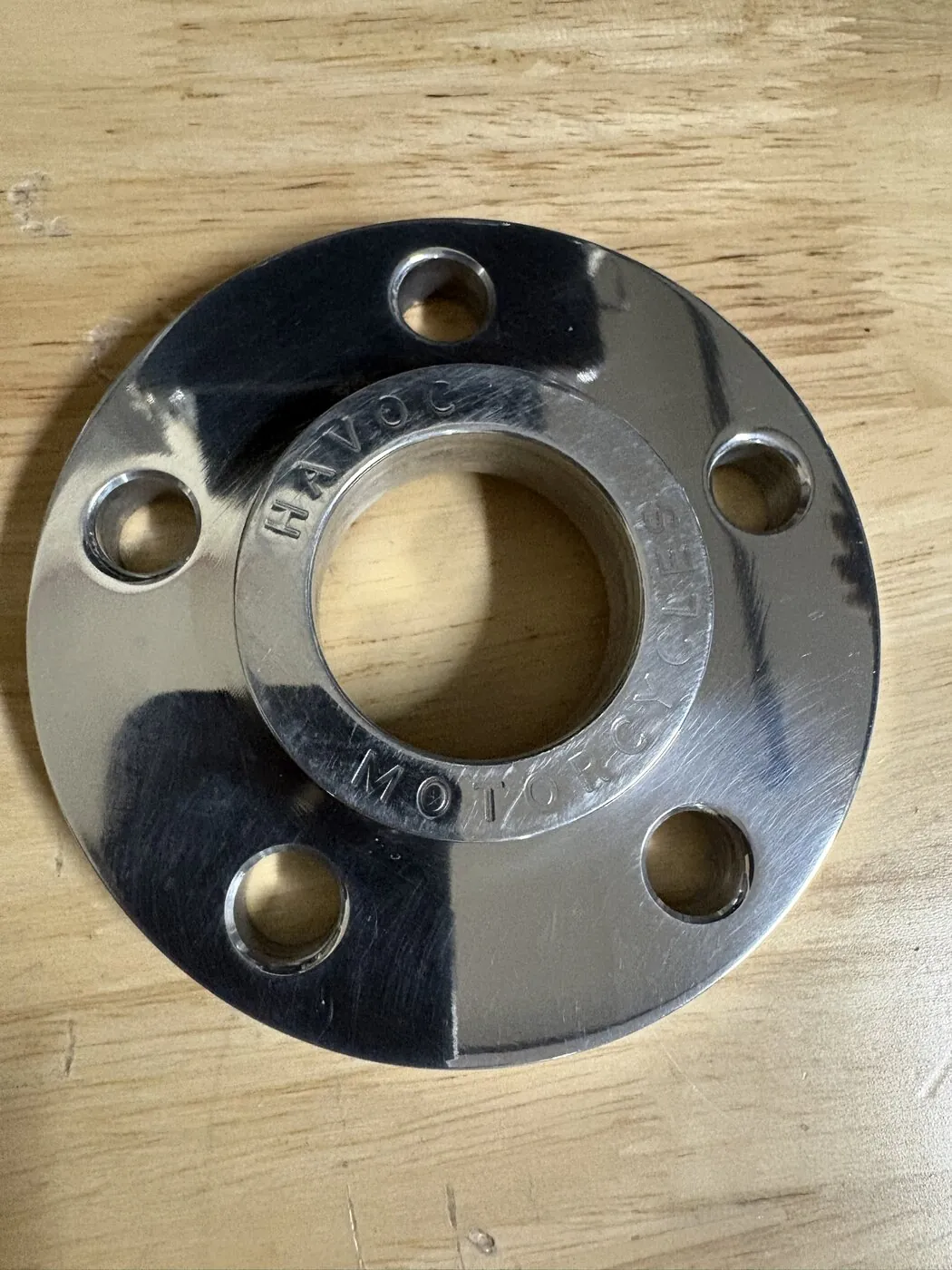
Harley-Davidson knows this, which is why calipers are shimmed at the factory so the rotor runs centered. It is not unusual to find different shim thicknesses on the left and right caliper bolts of a brand-new motorcycle. Those shims were chosen for the combination of parts on that bike when it was built. When you change the wheel or the rotors, you change the stack, and the original shims may or may not still be correct.
The rule
Every time new wheel or brake components are installed on a motorcycle, the calipers should be checked for alignment and free movement. When necessary, the calipers are shimmed so the rotor runs centered between the pads.
This is not a special requirement of custom wheels. It applies to any wheel or rotor change, including replacing stock parts with stock parts. It simply matters more with custom wheels because the parts come from a different production line.
How to check alignment
With the wheel installed and the axle torqued to specification:
- Look at the gap between the rotor and each pad. With the brake released, there should be a small, roughly equal clearance on both sides.
- Spin the wheel by hand. It should turn freely. Feel for resistance that comes and goes, and listen for a rhythmic drag or scrape.
- Apply and release the brake several times, then spin the wheel again. The pads should retract and the wheel should still turn freely.
- Check each caliper on a dual-disc front separately. Two calipers can be off in different directions.
On the bench, a rotor that is off-center usually shows itself as drag that is heavier on one side, a pad that wears faster than its partner, or a light, constant scraping sound. On the road, it can show as a pull to one side under braking on a dual-disc front, a spongy feel, or brakes that run hotter than they should.
How calipers are shimmed
If the rotor is not centered, the caliper is moved sideways until it is. That is done either by removing the factory shims or by adding new ones between the caliper and its mounting on the fork leg.
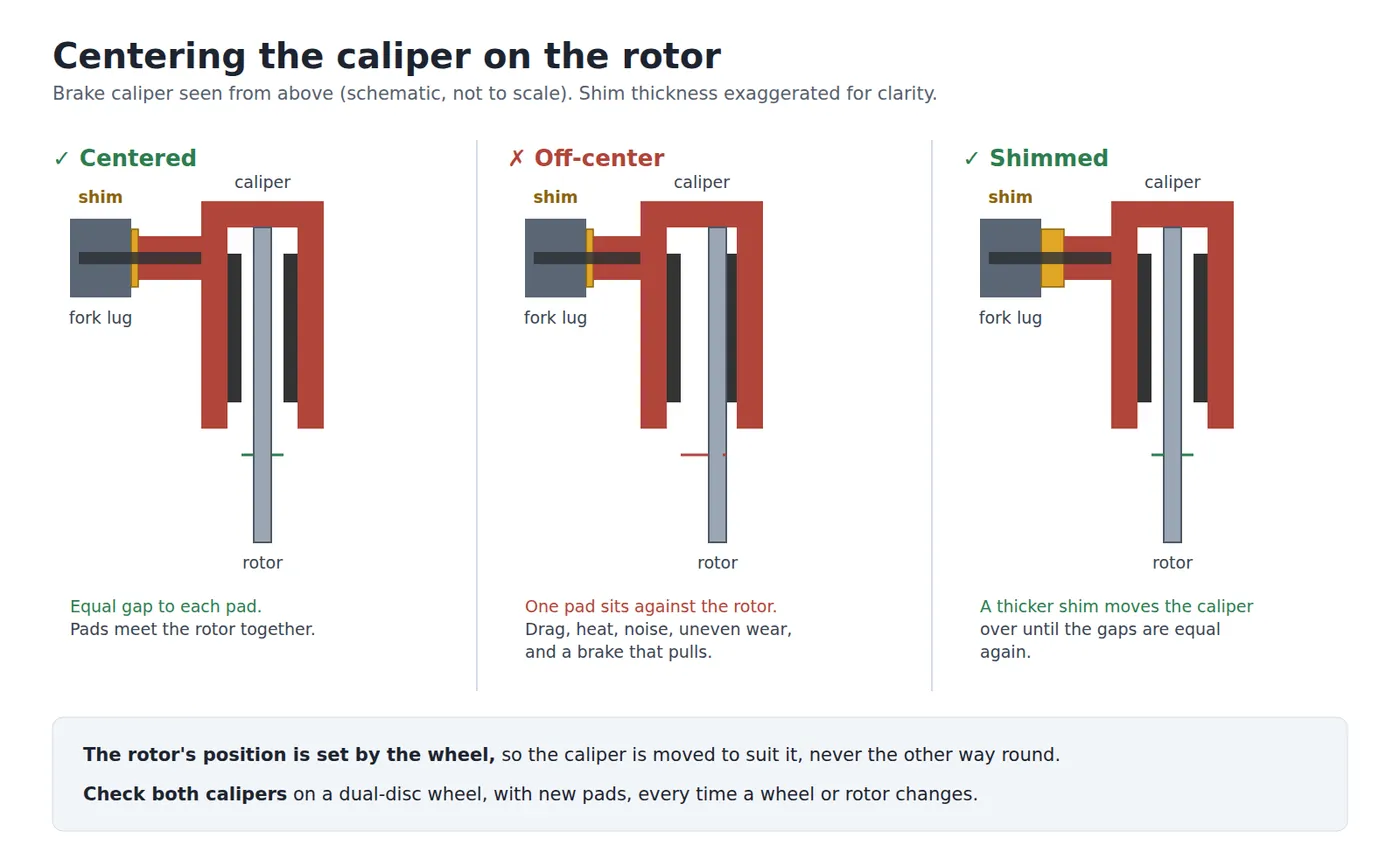
Caliper shims are simple precision washers. Arbor shim kits with a 3/8-inch inside diameter and 5/8-inch outside diameter, in assorted thicknesses from 0.001 inch to 0.125 inch in 0.001-inch increments, are widely available and give an installer everything needed to center a caliper precisely. The shims are fitted carefully between the caliper and the fork leg, on both mounting bolts, so the caliper moves parallel to the rotor rather than tilting. The aim is simple: the rotor spins between the pads with equal clearance on the inside and outside pad.
Most well-equipped shops keep a selection of shims in different thicknesses for exactly this job. If your installer does not, that is worth knowing before they start (see Choosing an Installer).
Use new pads
It is well worth fitting new brake pads when centering calipers on new rotors. Old pads have worn to match the old rotors, and pads can wear unevenly — one thicker than the other — which throws off any attempt to judge the center. New pads give you a known, even starting point, and they bed in to the new rotor surface from the beginning.
When the brakes pull to one side
The rotors are almost certainly not the cause. Rotors on our wheels are solid-mounted to the hub; they do not move relative to one another. When a motorcycle with new wheels pulls to one side under braking, or when one pad wears faster than the other, the cause is almost always caliper alignment. Have the calipers checked and shimmed. It is a short job for a shop that has the shims on hand, and it restores the even, progressive braking the motorcycle was designed to have.