

Wheels and tires are the most safety-critical components on a motorcycle. They carry the load, they transmit every bit of braking force and engine torque, and they are the only part of the machine touching the road. A badly installed wheel can cause anything from a dragging brake or a wandering belt to vibration, poor handling or a loss of control at speed. That is why we require custom wheels to be installed by a competent, experienced motorcycle technician.
That raises the obvious question: which technician? Not every motorcycle shop approaches a custom-wheel installation in the same way, and the answer is less obvious than it looks.
Stock-trained versus custom-experienced
Any competent technician experienced with Harley-Davidson motorcycles can install a set of wheels. But "competent with Harleys" and "comfortable with custom wheels" are not the same thing.
Should you take your motorcycle to your local Harley-Davidson dealer? Perhaps, and perhaps not. Many riders have had excellent experiences having custom parts installed at authorized dealerships, and some have not. In our experience, most dealer service departments are perfectly capable of installing a wheel that is the exact stock size. Some appear to be outside their comfort zone the moment a wheel differs from stock in any respect: a different diameter, a different width, a different bearing, a different pulley offset.
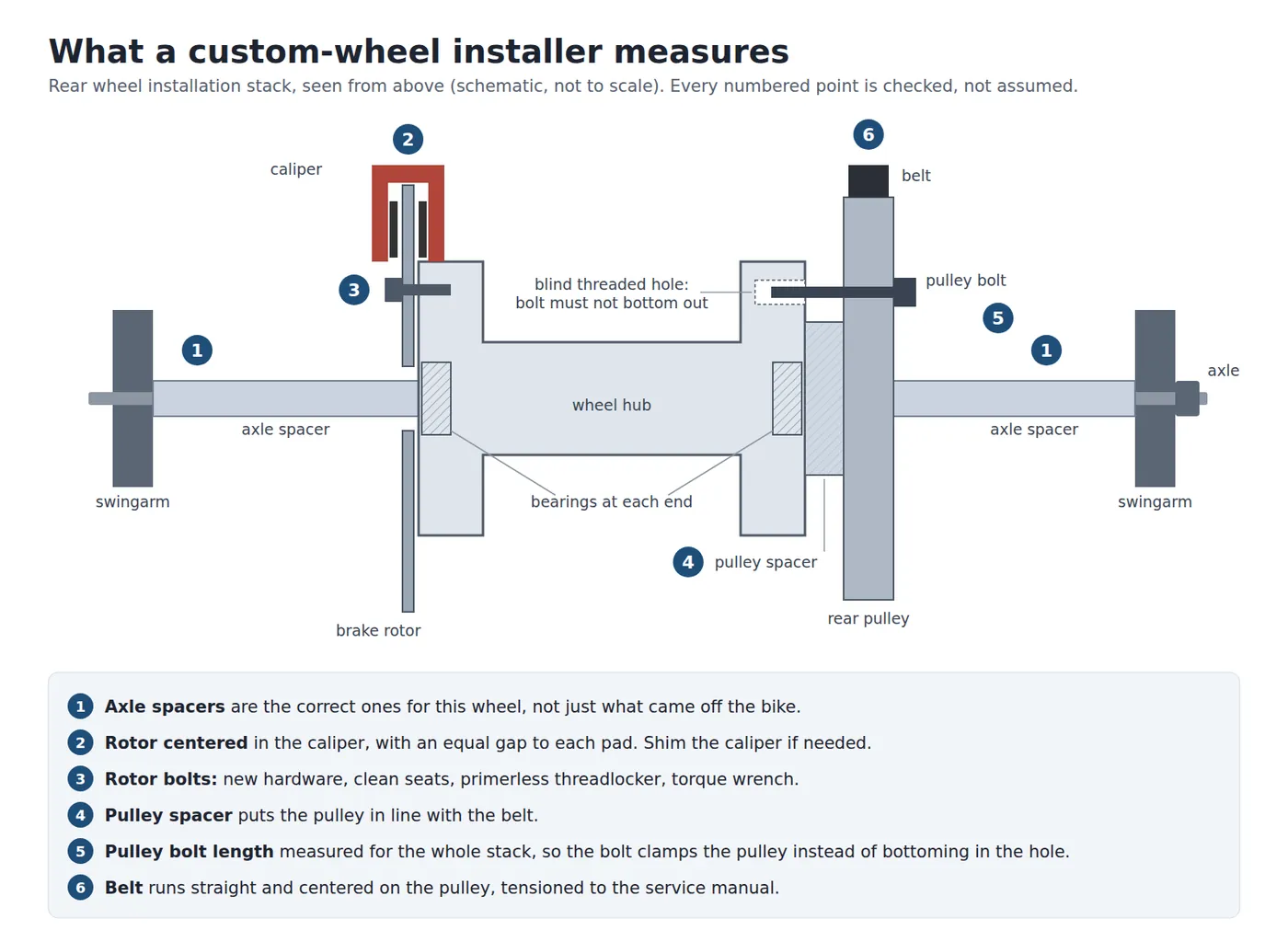
This should not surprise anyone, and it is not a criticism. Dealer technicians are trained to maintain stock vehicles to factory specification. Their service manuals, parts microfiche and flat-rate times all assume the motorcycle is as it left the factory. Custom wheels, by definition, are not. Custom wheels can call for a different axle spacer, a caliper shim, a pulley spacer or a different pulley bolt length. Those problems are solved with a micrometer, a selection of spacers and shims, experience, and often a lot more shop time, not with an OEM part number.
Independent shops vary just as widely. Some do custom work every day; others mostly do oil changes and tires. The sign on the door tells you very little. How the shop answers a few specific questions tells you a great deal.
Questions to ask before you book
Before choosing an installer, ask whether the shop is comfortable working with custom wheels, and whether the technician is used to dealing with the differences between factory and aftermarket components. Then ask:
- Do you keep a range of caliper shims, axle spacers and pulley spacers on hand? Havoc supplies the spacers and hardware required for our wheel packages. Even so, an experienced custom shop will generally have its own spacers and shims, know what they are and know how to use them. Some shops do not, and a shop that has to order everything will have your bike on a lift for a lot longer.
- Will you verify wheel, brake and belt alignment as part of the installation? The correct approach is not simply to install the wheel to the dimensions expected for a stock motorcycle. The completed assembly should be checked to confirm the wheel is correctly positioned, each brake rotor is centered in its caliper, and the rear pulley and belt are correctly aligned. (See Centering Your Brake Calipers After a Wheel Change and Rear Pulley Spacers and Belt Alignment.)
- How do you confirm pulley bolt length? The right answer involves measuring the complete stack of pulley, spacer and washers against the depth of the threaded hole. "We use the factory bolts" is the wrong answer. (See Pulley Bolts and Aluminum Hubs.)
- Where do you buy fasteners? It sounds trivial, but a shop that knows its nearest industrial fastener supplier can get the correct bolt the same day, instead of making do with the wrong one.
- Have you installed this size before? If you are going to a 21-, 23- or 26-inch front, or a 180mm fat front tire, the job may involve a raked triple tree, a new fender and a headlight or fairing correction. Ask whether they have done it, and on which models.
A good shop should be comfortable answering these questions.
Your motorcycle may not be stock
These questions matter because the motorcycle you bring to the shop may not be completely stock, whatever you believe about it. Previous owners may have fitted aftermarket pulleys, suspension components, fenders or other parts that change the installation dimensions. Sometimes a motorcycle has been retrofitted with wheels from a completely different model, along with that model's axle spacers.
Our wheels are designed to install with the correct stock axle spacers for your model. The key word is correct. Simply reusing whatever spacers come off the bike, without confirming they are the right ones, is the last thing you should do. An experienced custom-wheel technician will recognize these differences and know how to measure and correct them. A shop that mainly installs replacement parts to factory dimensions may not even notice, and that can be really bad.
A case study: when installation goes wrong
There is a reason we put so much emphasis on verification.
We have seen a case - unfortunately more than once - where a customer calls with the same story looking for our advice: they bought a rear wheel on eBay, took it to a shop, and had it installed using hardware that was the correct factory specification for the motorcycle, but the bolts sheared off mid-ride and caused a very dangerous situation. What happened?
First, the installer never checked the actual assembled dimensions. The OEM pulley bolts were too long for that wheel and pulley combination. It gets worse: the installer tightened the pulley bolts with an air tool and did not realize that the bolts had bottomed out in the threaded holes before the pulley was fully clamped against the wheel. The torque reading was misleading. The fasteners appeared to reach the required torque, but the bolt heads were not tight against the pulley, so the pulley was never secured.
The bolts later sheared, and the rider lost control of the motorcycle.
The lesson is simple: OEM part numbers and torque specifications do not make an incorrectly assembled installation safe. Bolt length, thread engagement, pulley seating and the complete installation stack must be physically checked before the motorcycle is ridden.
The shop you want
You don't necessarily need a shop that works only on custom motorcycles. You do want a technician who understands that a custom-wheel installation is an exercise in measuring and checking, not just swapping parts.
A good installer should be prepared to:
- Verify the wheel and bearing configuration for the motorcycle.
- Confirm axle and axle spacer dimensions.
- Dry-fit the wheel, rotors and pulley before the tire is mounted (see Dry-Fit First).
- Confirm that every fastener threads in freely by hand before any torque is applied, and use the correct threadlocker on each.
- Confirm pulley bolt length and thread engagement.
- Torque rotor and pulley bolts with a calibrated torque wrench, never an impact or air tool.
- Check brake rotor-to-caliper alignment, and shim the calipers if needed.
- Verify rear pulley position and belt alignment.
- Follow the service manual for your model and year when reinstalling the axle, including sequences and torque values.
- Check all clearances before the motorcycle leaves the shop.
- Stop and investigate if something does not assemble or torque correctly.
If a technician finds something that doesn't look right, the correct response is to stop and find out why, not to force the parts together.
When you pick up your bike, it is reasonable to ask whether each of these checks was done, and to ask for an itemized installation invoice. Keep it with your proof of purchase: our warranty requires professional installation, and the invoice is how you show it.
A word on doing it yourself
We know many of our customers are capable home mechanics, and many also build entire motorcycles. Even so, our advice stays the same: do not install custom wheels yourself unless you have the tools, the measuring instruments and the experience to do everything on the list above. The critical steps (caliper centering, pulley bolt length, belt alignment, torque) are exactly the ones that are easy to skip and expensive to get wrong.
If you are unsure where to go, get in touch. We work with a network of experienced shops across the country, and depending on where you live, we may be able to recommend one. Call us toll-free at 1-800-560-3963 or 1-855-MYHAVOC (1-855-694-2862).