
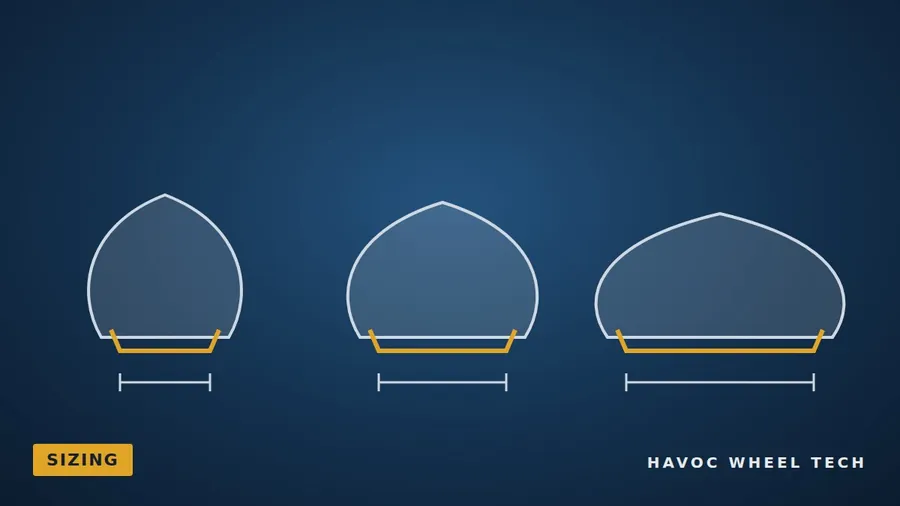
This is one of the most common points of confusion we see. Factory Harley-Davidson wheels typically come in widths like 3, 5 or 8 inches: a 16 x 3 or 19 x 3 front, a 16 x 5 or 18 x 5 rear. Aftermarket wheels, including ours, are a half size wider: 3.5, 5.5 or 8.5 inches. Riders understandably wonder whether the aftermarket wheel needs a different tire, whether their stock-size tire will fit it properly, or whether the wheel will fit the motorcycle at all.
The short answer: an aftermarket wheel built for your model takes the same tire as the factory wheel it replaces, and it fits the motorcycle in exactly the same way. The longer answer is a question every custom builder eventually asks, and the rest of this page answers it: which tire fits which rim?
Why aftermarket wheels come in half sizes
The half sizes are not a styling choice. They come from how aftermarket wheels are made. Rims, and the billet aluminum blanks from which machined wheels are cut, are produced in standard widths, and the widths available to the aftermarket are overwhelmingly the half sizes: 3.5, 5.5 and 8.5 inches. A factory wheel is designed around a single specified tire, the manufacturer's own production methods and its cost targets. An aftermarket wheel is built from the standard material available to the industry, and designed to suit a range of tires across a range of builds.
The half inch does not matter to the tire, because tires are not designed for a single rim width.
Every tire fits a range of rim widths
For every size they make, tire manufacturers publish a range of approved rim widths, together with a "measuring rim": the specific width on which the tire's published dimensions were measured. Any rim inside the approved range is correct for that tire.
Rim width is measured between the bead seats, the inside surfaces where the tire's beads sit against the rim, not across the outside of the rim flanges. So when two wheels differ by half an inch, what differs is how far apart the tire's two beads are held. The diameter of the bead seat, which is what the "16," "18" or "21" refers to, is exactly the same.
You may also see a rim written as MT3.00 x 16 or MT3.50 x 16. The MT prefix identifies a drop-center rim profile of the type used for tubeless motorcycle tires, and the number that follows is the width. Both are standard.
Factory and aftermarket widths, side by side
Here is how the common Harley-Davidson factory widths and their aftermarket half-size equivalents compare against the approved rim ranges in the charts below:
| Factory wheel | Aftermarket wheel | Tire | Approved rim width |
|---|---|---|---|
| 16 x 3 | 16 x 3.5 | 130/90-16 | 2.50–3.50 in |
| 16 x 3 | 16 x 3.5 | 150/80-16 | 3.00–4.00 in |
| 18 x 3 | 18 x 3.5 | 130/70-18 | 3.00–4.00 in |
| 19 x 3 | 19 x 3.5 | 130/60-19 | 3.00–3.75 in |
| 21 x 3 | 21 x 3.5 | 130/60-21 | 3.00–4.00 in |
| 16 x 5 | 16 x 5.5 | 180/65-16 | 4.50–5.50 in |
| 16 x 5 | 16 x 5.5 | 180/70-16 | 5.00–6.00 in |
| 18 x 5 | 18 x 5.5 | 180/55-18 | 5.50–6.00 in |
| 17 x 6 | 17 x 6.25 | 200/55-17 | 6.00–6.50 in |
| 18 x 8 | 18 x 8.5 | 240/40-18 | 8.00–9.00 in |
In almost every row, both the factory width and the aftermarket half size fall inside the tire's approved range. The one exception is instructive: the general chart lists the 180/55-18 for rims of 5.5 to 6.0 inches, while Harley-Davidson fits that size to an 18 x 5 wheel, with tires built specifically for its own rim. The aftermarket 18 x 5.5 sits squarely inside the general range. Either way, the tire stays the same. What changes is the shape it takes on the rim, and only slightly.
What the extra half inch changes
A wider rim spreads the tire's beads slightly further apart. The result is a small change in shape, not a change in fit:
- The sidewalls stand a little more upright. On a narrower rim, the sidewalls angle inward toward the beads; on a wider one, they rise more vertically.
- The tread profile becomes slightly fuller. The crown of the tire is supported a little more squarely.
- The mounted section width grows slightly. As a rule of thumb, each additional half inch of rim width adds roughly a quarter inch to the tire's mounted width. The tire looks slightly wider and more muscular, which is one reason many riders prefer the wider rim.
What does not meaningfully change is the tire's overall diameter. The sidewall height and the bead-seat diameter are the same, so the tire stands the same height on either rim. Steering geometry, ride height, speedometer reading and fender clearance are unaffected.
The extra half inch is also in the rim, not the hub. An aftermarket wheel built for your model has the same hub width, the same bearings, the same axle spacers, and the same brake rotor and pulley positions as the factory wheel it replaces. It bolts into the motorcycle exactly as the stock wheel does.
Why staying inside the range matters
Rim width can be critical to handling and stability, which is why the approved ranges exist and why they should be respected.
- A rim wider than recommended flattens the tire's profile. The tire can feel reluctant to lean, and a rider can reach the edge of the tread sooner than expected in a corner.
- A rim narrower than recommended pinches the tire into a pointed profile, altering how it steers and reducing the contact patch under braking.
- Either extreme can compromise the bead seal, with the risk of the tire slipping on the rim or losing air.
Inside the approved range, none of this applies. That is the whole purpose of the range.
Tire and rim fitment chart: front tires
All rim widths below are taken from tire manufacturers' recommendations. Ranges can differ slightly between tire makers and between tire models in the same size, so always confirm the exact tire you plan to fit.
| Rim diameter | Tire size | Approved rim width (in) |
|---|---|---|
| 16 in | 110/90-16 | 2.15–3.00 |
| 120/80-16 | 2.50–3.00 | |
| 130/70-16 | 3.50–4.00 | |
| 130/90-16 | 2.50–3.50 | |
| 150/80-16 | 3.00–4.00 | |
| 17 in | 110/70-17 | 3.00–3.50 |
| 110/80-17 | 2.15–3.00 | |
| 120/60-17 | 3.50–3.75 | |
| 120/70-17 | 2.75–3.75 | |
| 120/80-17 | 2.50–3.00 | |
| 120/90-17 | 2.50–3.00 | |
| 140/80-17 | 3.00–4.00 | |
| 150/80-17 | 3.00–4.25 | |
| 18 in | 100/90-18 | 2.15–2.75 |
| 110/80-18 | 2.15–3.00 | |
| 110/90-18 | 2.15–3.00 | |
| 120/70-18 | 3.00–3.75 | |
| 120/90-18 | 2.50–3.00 | |
| 130/60-18 | 3.50–4.00 | |
| 130/70-18 | 3.00–4.00 | |
| 140/70-18 | 3.00–4.50 | |
| 19 in | 90/90-19 | 1.85–2.50 |
| 100/90-19 | 2.15–2.75 | |
| 110/90-19 | 2.15–3.00 | |
| 120/70-19 | 3.00–3.75 | |
| 130/60-19 | 3.00–3.75 | |
| 20 in | 120/70-20 | 3.50 |
| 140/60-20 | 3.75 | |
| 150/55-20 | 4.50 | |
| 21 in | 80/90-21 | 1.60–2.15 |
| 90/90-21 | 1.85–2.50 | |
| 120/70-21 | 3.00–3.75 | |
| 130/60-21 | 3.00–4.00 | |
| 140/70-21 | 3.00–3.75 | |
| 23 in | 120/70-23 | 3.50–4.00 |
| 130/50-23 | 3.50–4.00 | |
| 130/60-23 | 3.00–3.75 | |
| 24 in | 130/70-24 | 4.00 |
| 26 in | 120/50-26 | 3.50–3.75 |
| 120/55-26 | 3.50–3.75 | |
| 30 in | 140/40-30 | 4.00 |
Tire and rim fitment chart: rear tires
| Rim diameter | Tire size | Approved rim width (in) |
|---|---|---|
| 16 in | 130/90-16 | 2.50–3.50 |
| 140/90-16 | 2.75–3.75 | |
| 150/80-16 | 3.00–4.00 | |
| 160/80-16 | 3.50–4.50 | |
| 170/70-16 | 4.25–5.50 | |
| 180/60-16 | 4.50–5.50 | |
| 180/65-16 | 4.50–5.50 | |
| 180/70-16 | 5.00–6.00 | |
| 200/60-16 | 5.50–6.25 | |
| 240/50-16 | 7.00–8.00 | |
| 17 in | 120/90-17 | 2.50–3.00 |
| 130/90-17 | 2.50–3.50 | |
| 140/70-17 | 3.50–4.50 | |
| 140/80-17 | 2.75–4.00 | |
| 150/60-17 | 4.00–4.75 | |
| 150/70-17 | 4.25–4.50 | |
| 160/60-17 | 4.25–5.00 (5.50 for some sport tires) | |
| 160/70-17 | 3.75–5.00 | |
| 170/60-17 | 4.25–5.50 | |
| 180/55-17 | 5.50–6.00 | |
| 180/60-17 | 5.00–5.50 (4.50 for some models) | |
| 190/50-17 | 6.00–6.50 | |
| 190/55-17 | 6.00–6.50 | |
| 190/60-17 | 5.00–6.00 | |
| 200/50-17 | 6.00–6.50 | |
| 200/55-17 | 6.00–6.50 | |
| 210/50-17 | 6.00–7.00 | |
| 240/45-17 | 8.00–9.00 | |
| 300/35-17 | 10.00–11.00 | |
| 330/30-17 | 11.00–12.50 | |
| 18 in | 110/90-18 | 2.15–3.00 |
| 120/90-18 | 2.50–3.00 | |
| 130/80-18 | 2.50–3.50 | |
| 140/70-18 | 3.00–4.50 | |
| 150/70-18 | 3.50–4.50 | |
| 160/60-18 | 4.25–5.00 | |
| 170/60-18 | 4.00–5.00 | |
| 180/55-18 | 5.50–6.00 | |
| 200/50-18 | 5.50–6.50 | |
| 200/55-18 | 5.50–6.50 | |
| 210/40-18 | 7.00–8.00 | |
| 240/40-18 | 8.00–9.00 | |
| 250/40-18 | 8.50–9.50 | |
| 260/35-18 | 8.50–9.50 | |
| 260/40-18 | 8.50–9.50 | |
| 280/35-18 | 9.50–10.50 | |
| 300/35-18 | 10.00–11.00 | |
| 310/35-18 | 10.00–11.00 | |
| 360/30-18 | 13.00 |
Notes to the rear chart. For the 160/60-17, most tires are approved for rims of 4.25 to 5.00 inches; some sport tires in this size are also approved for a 17 x 5.5 rim. For the 180/60-17, only certain tire models are approved for a 17 x 4.5 rim. In both cases, check the specific tire.
Lettered tire sizes
Some motorcycle tires, particularly older and touring designs, use a lettered size instead of a metric width. The letters give the tire's width:
| Letter code | Section width |
|---|---|
| MH | 80 mm |
| MJ | 90 mm |
| MM | 100 mm |
| MN | 110 mm |
| MR | 120 mm |
| MT | 130 mm |
| MU | 140 mm |
| MV | 150 mm |
The numbers that follow work exactly as in a metric size. An MU90-16, for example, is 140mm wide, with a 90 percent profile, for a 16-inch rim. An MT90-16 is the lettered equivalent of a 130/90-16. To convert millimetres to inches, divide by 25.4.