
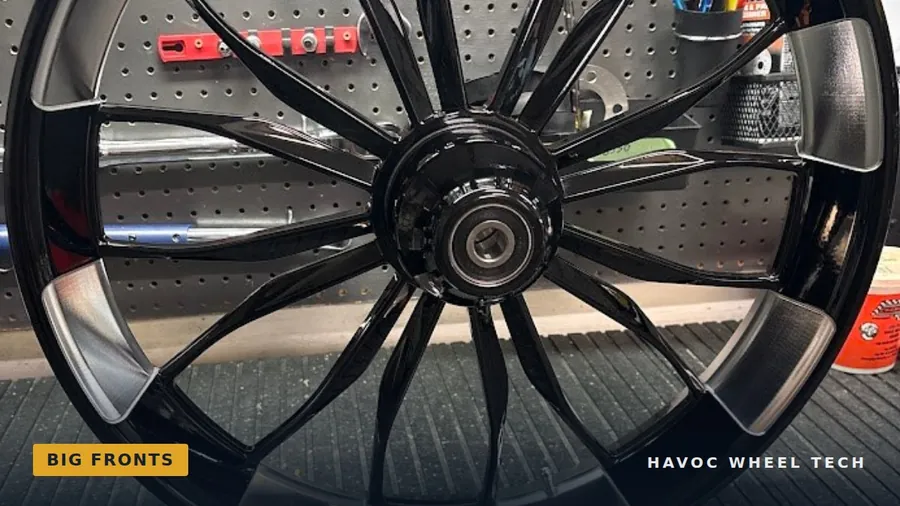
A big front wheel transforms the look of a Harley-Davidson, especially a bagger. It also changes the geometry of the motorcycle. How much it changes, and what else has to change with it, depends on how big you go. The dividing line is simple: the more the overall diameter of the wheel and tire grows, the more of the motorcycle has to be adapted to it.
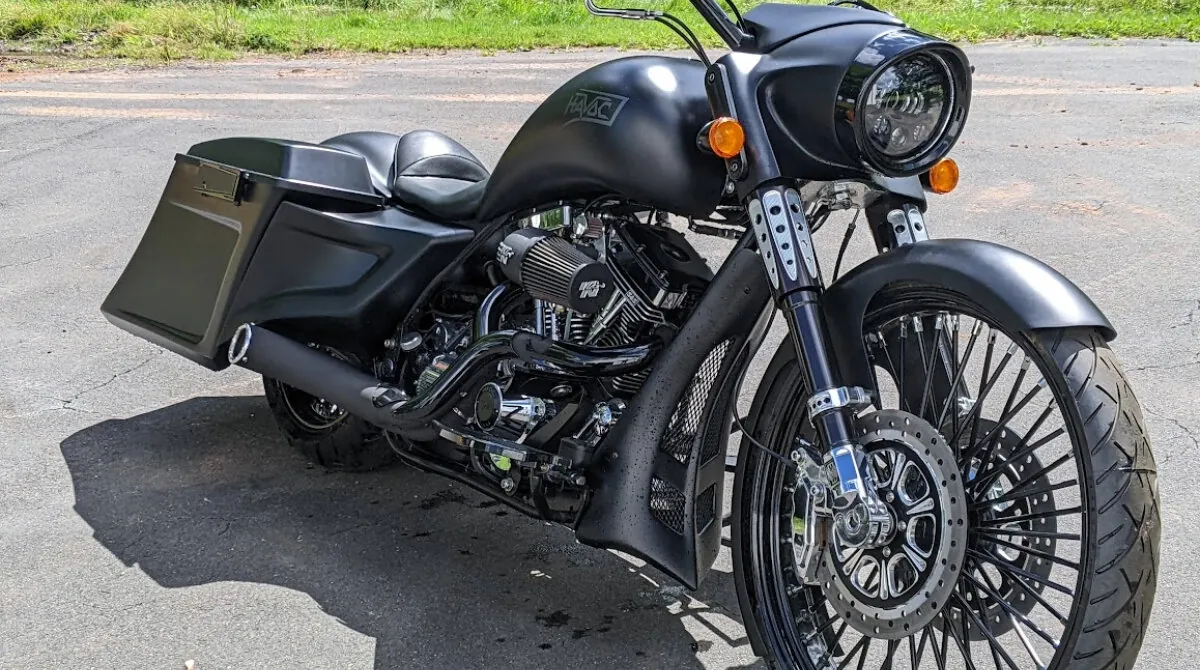
Why size matters beyond the rim
The stock Touring front tires, from 16 to 19 inches, all stand about 25.2 inches tall (see How to Read Motorcycle Tire and Rim Sizes). A 21-inch front with a 120/70-21 tire stands about 27.6 inches tall. A 23-inch front with a 130/60-23 stands about 29 inches tall, and a 26-inch front is taller again.
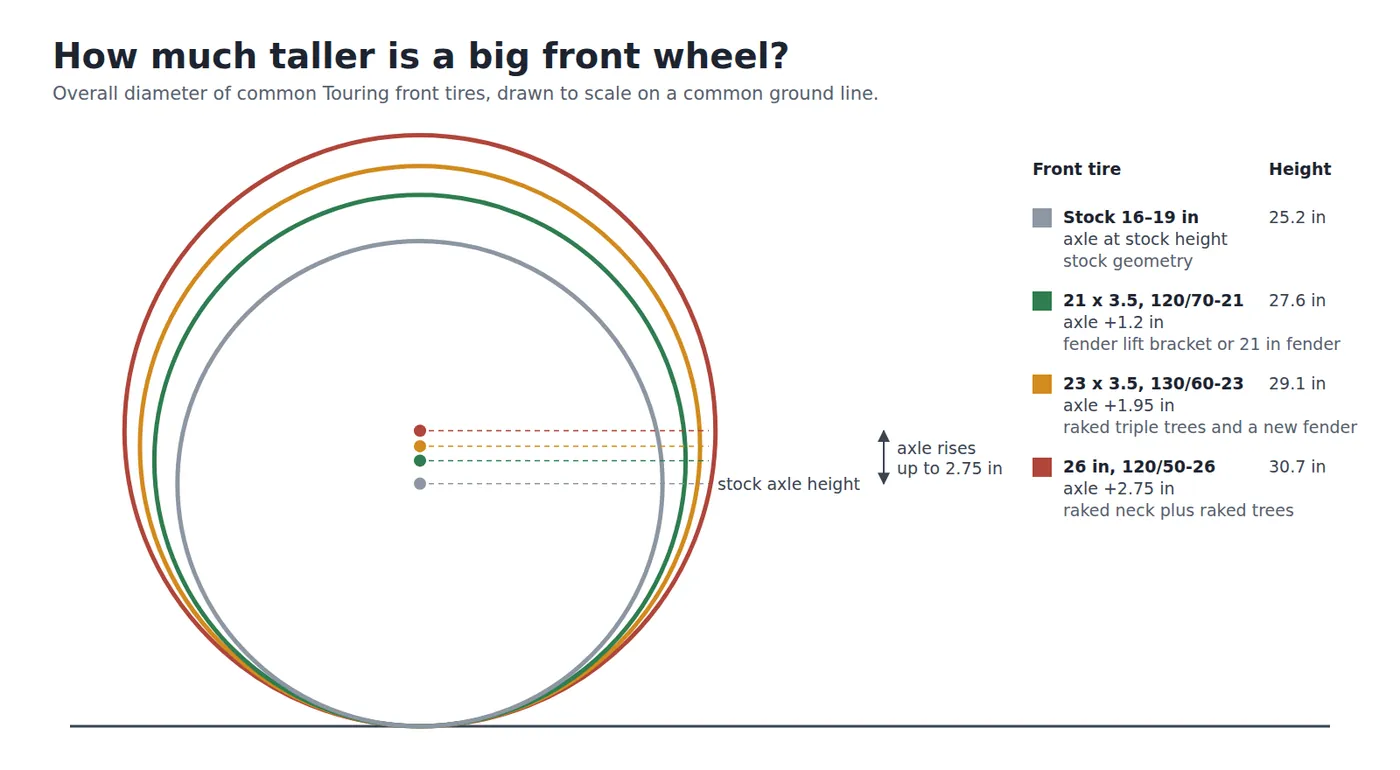
Every extra inch of diameter lifts the front axle by half an inch and pushes the tire closer to the fender. It also changes the steering geometry. Raising the front of the motorcycle tips the chassis back slightly, which increases rake and trail: a 21-inch front on a Touring model adds roughly 0.9° of rake and three-quarters of an inch of trail, so the motorcycle becomes a little more stable and takes slightly more effort to turn in. It also changes the angle at which the headlight or fairing points. Small increases can be accommodated with a fender change. Large ones need the front end re-engineered to put the geometry back.
21-inch fronts
On every Touring model, and on nearly every Softail, a 21 x 3.5 front wheel is the largest that fits without chassis modification (see the Touring and Softail wheel and tire size tables). It does, however, need more room than the stock fender provides. There are two ways to get it:
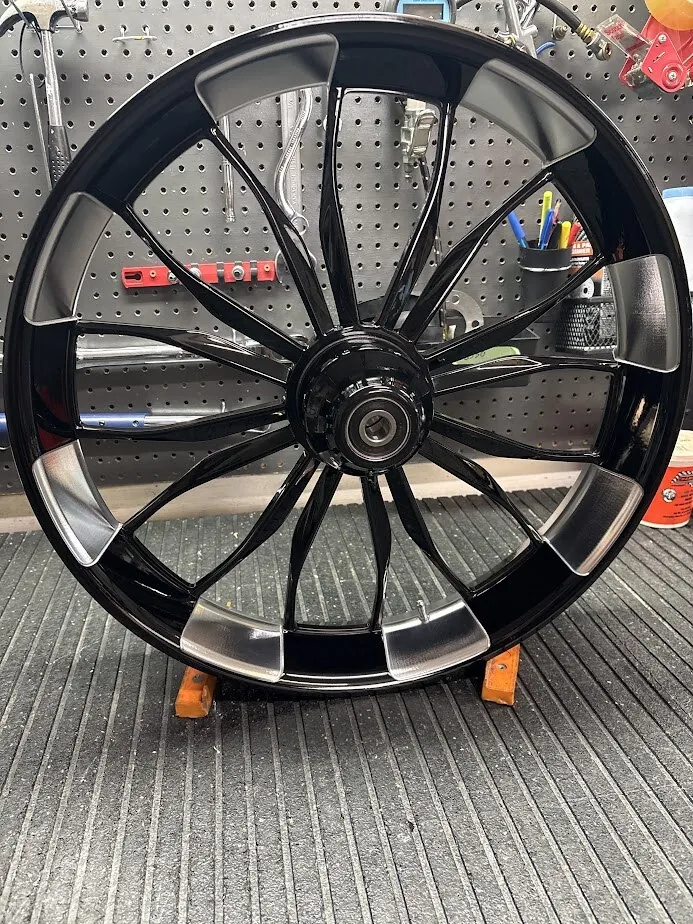
- A fender lift bracket, which raises the stock fender to clear the taller tire. It is the more economical choice and keeps your original painted fender.
- A 21-inch fender, shaped to follow the larger wheel, with the appropriate spacers. It usually gives the cleanest look.
We can supply either. On Softails with an engine guard, a lifted fender brings a risk of the fender contacting the guard when the fork bottoms on a sharp bump. Softail forks do not have the internal cartridges of the Touring forks and are more prone to bottoming, so we recommend progressive-rate fork springs if you have an engine guard and typically ride on roads that are in poor condition, or take the bike out in early spring before the roads are patched. For what a 21-inch front does to ride height, fender clearance and steering, see Sizing and Fitment: Front vs Rear, 16, 18 and 21 Explained.
A 21-inch front on a 2014-and-later bagger
The 2014 model year brought 49mm forks, a new fender mounting and, on most Touring models, ABS as standard. None of that changes the basic answer: a 21 x 3.5 front with a 120/70-21 or 130/60-21 tire fits every 2014-and-later Touring model in the stock triple trees. What changes are the details:
- Fender parts are year-specific. Lift brackets and 21-inch fenders for 2014-and-later models are not the same as those for earlier bikes. Order the parts for your model year.
- ABS. An ABS motorcycle needs an ABS bearing matched to the 21-inch diameter, on the left side (see Which Way Does the Wheel Go?).
- Brake lines. With stock trees, the brake lines normally need no change. Check them lock to lock anyway, as described below.
If you want to go beyond a 21 x 3.5, to a 21 x 5.5, a 23 or a 26, see the sections that follow.
23-inch fronts and 21 x 5.5 fat fronts
A 23 x 3.5 wheel with a 130/60-23 tire, and a 21 x 5.5 wide wheel with a 180/50-21 tire, are in a different category. Both are well beyond what the stock front end can accommodate, and both must be installed with a raked triple tree (see Rake, Trail and Raked Triple Trees: What Big Front Wheels Do to Your Harley's Steering).
A raked tree changes the angle of the fork legs relative to the frame's steering head, moving the front axle forward to pull back the extra trail the taller wheel adds. The fat 21 and the standard 23 are of a similar overall diameter and use the same triple tree. Because Harley-Davidson changed the Touring fork from 41mm to 49mm tubes in 2014, raked trees are model-specific: one design for 2013-and-earlier Touring models and another for 2014-and-later. Install the tree strictly according to its manufacturer's instructions.
It is not possible to lift the stock fender far enough to clear these sizes. A new fender, designed for the wheel, is required.
23 x 5.5 and 26-inch fronts
A 23 x 5.5 or 26-inch front is the most dramatic conversion of all. Both must be installed with a raked neck and triple tree kit, and the job should be treated as a front-end rebuild rather than a wheel swap (see Rake, Trail and Raked Triple Trees: What Big Front Wheels Do to Your Harley's Steering). That makes the choice of installer more important than ever. Many shops that are comfortable with a wheel swap are not comfortable installing a raked neck kit, so interview any shop — dealer or independent — and ask specifically about raked tree installations before booking. Do not attempt this installation yourself.
We recommend a tube in 26-inch tires; they perform better and hold air much better with one.
Correcting the headlight or fairing angle
A raked front end and a taller wheel change the angle at which the headlight or fairing sits, and the headlight beam will usually aim higher than it should unless it is corrected. You should correct the headlight angle whenever a raked tree is installed. The correction depends on the fairing:
- Batwing fairings (Street Glide, Electra Glide): the most economical fix is a headlight wedge, which re-aims the headlight within the fairing.
- Frame-mounted fairings (Road Glide): an adjustable fairing bracket lets you set the angle of the whole fairing to suit your eye and the new geometry.
Correct headlight aim is not just about looks. A headlight pointing into the eyes of oncoming drivers is dangerous and, in many jurisdictions, illegal.
ABS brake lines
On motorcycles with ABS, pay close attention to how the front brake hoses are routed across the lower triple clamp when a raked tree is installed. In most cases you do not need new hoses. You need to route the existing ones differently, so they are not stretched, kinked or pinched as the fork turns from lock to lock.
Setting up the front end: no wobble, no head shake
A big front wheel should steer as smoothly as the stock one, and it will, provided the front end is set up correctly. When a rider reports a wobble, a shake in the bars or a weave after a front wheel change, it usually comes down to one of the following. Check them in this order, and you will almost always find it:
- Fork leg alignment. When the front wheel is installed, the fork sliders must be allowed to find their natural, parallel position before they are clamped to the axle. Follow the sequence in the service manual for your model. In outline: tighten the axle, leave the slider pinch bolts loose, pump the fork up and down several times with the front brake released, and only then tighten the pinch bolts to specification. A fork clamped with the legs twisted binds, and a binding fork steers badly.
- Steering head bearings. A larger, heavier front wheel magnifies any looseness or notchiness in the steering head bearings. Check the adjustment according to the service manual whenever the front end has been apart, and especially after a raked tree has been installed. A steering head that is too tight can interfere with the motorcycle's ability to absorb a weave, while one that is too loose can interfere with its ability to absorb a wobble.
- Tire pressure. Set it cold, to the pressure recommended for the tire and the load. A low front tire is one of the most common causes of a weave.
- Tire seating and balance. Check that the tire's molding line sits evenly above the rim all the way around, on both sides. A tire that is not seated evenly will never run true, however well it is balanced. Then confirm the wheel is balanced.
- Wheel runout. A bent wheel, or debris trapped between the rotor and the hub, will show up as a wobble at speed (see Runout Tolerances: Why Thousandths Matter).
- Tire condition. On heavy touring motorcycles, a front tire that has worn unevenly, or cupped, is a well-known cause of a wobble when slowing down, typically in the 30 to 45 mph range. It is worth checking the front tire before blaming the wheel.
- The rear of the motorcycle. A wobble felt through the bars can start at the back: rear axle alignment, a worn swingarm bearing, low rear tire pressure or a heavily loaded top case. Check them too.
- Geometry. If a 21 x 5.5, 23 or 26-inch front is fitted without the raked trees or frame rake its size needs, the trail will be wrong for the motorcycle, and no amount of adjustment will fix that. See Rake, Trail and Raked Triple Trees.
Work through the list methodically, one item at a time. A front end that has been set up properly, with the right geometry for the wheel, steers cleanly and holds a straight line at any speed.
Check everything, lock to lock
When the installation is complete, turn the handlebars slowly from full left to full right and check that nothing binds, stretches or contacts: brake lines, wiring, the fender, the fairing, the tire. Then check the fork at full compression. A big front wheel is a spectacular change, and the installation deserves the same care the look does.