
A single-disc wheel can only go on one way: the rotor has to line up with the caliper, and the ABS bearing goes at the rotor. A dual-disc front wheel is symmetrical, with a rotor on each side, and will physically fit in either direction. That leads to one of the most frequent questions we are asked: can a dual-disc wheel be installed either way round?
The answer is that physically the rotor offset on either side is the same. So if you have a non-ABS wheel, it is entirely possible to put it on the bike in either orientation. But that is exactly why a dual-disc wheel can end up the wrong way round. The first consideration is the valve stem. If it sits on one side of the wheel, as it does on our Fat Spoke wheels, you will want it on the high side of the motorcycle when it is on its side stand, where it is easiest to reach for checking and adjusting tire pressure. If the wheel has an ABS bearing, this always goes on the left on a Harley, against the wheel sensor on the axle. Both are important: when we install an ABS bearing, the ABS is left and the valve stem is on the right.
And mounting tires, there is a third consideration.
Tires are directional
Most motorcycle tires are directional: they are designed to roll in one direction only. The tread pattern is shaped to clear water in that direction, and the internal construction — the way the plies and belts overlap and the way the tread was joined when the tire was made — is designed to carry acceleration and braking forces in that direction.
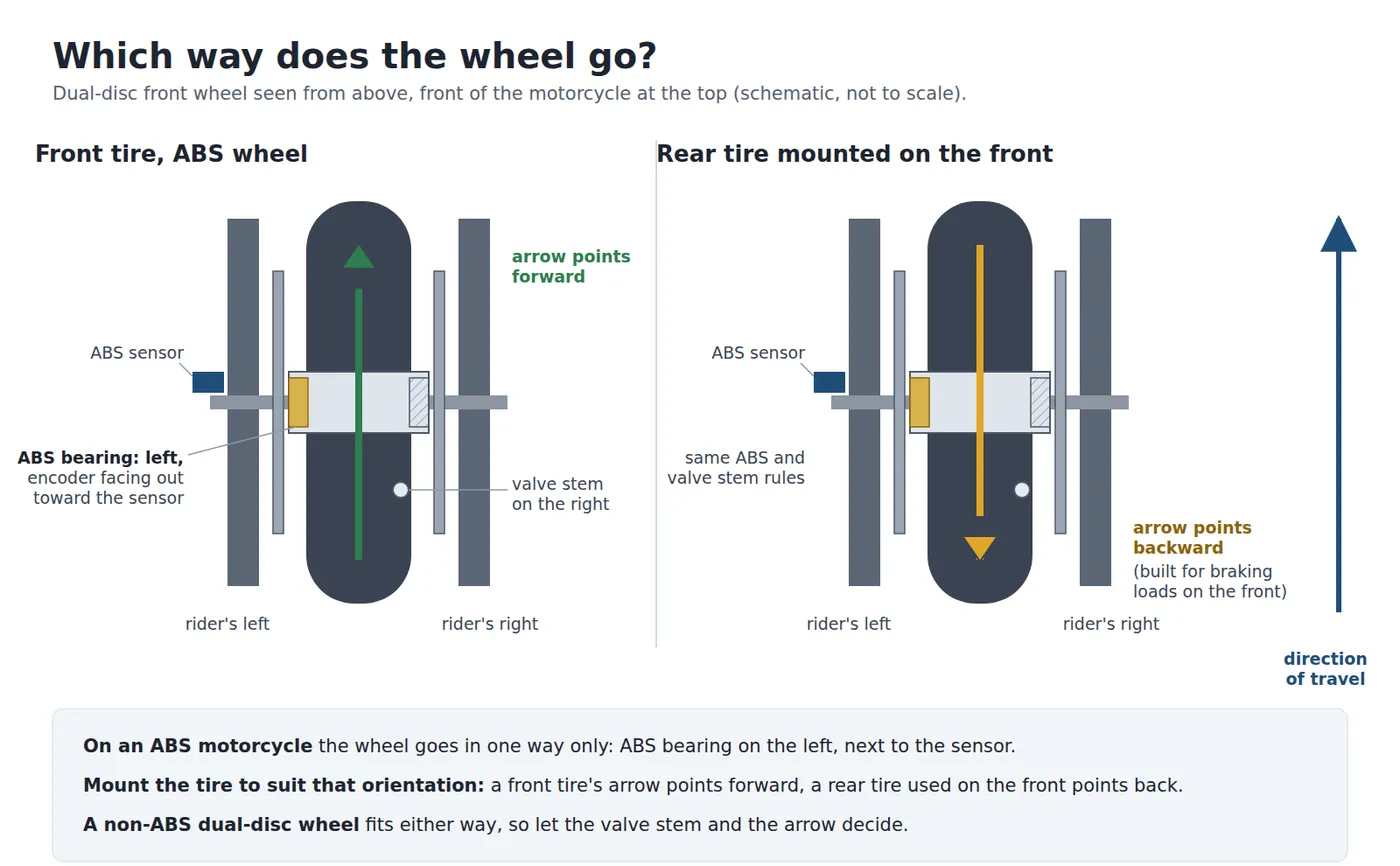
Look closely at the sidewall and you will find an arrow. The tire should always roll in the direction of the arrow when the motorcycle is moving forward. The exception is a rear tire used on the front, as in a fat front tire conversion, where the tire is deliberately mounted the other way round (see Rear tires on the front, below). On a dual-disc wheel with a tire already mounted, that arrow decides which way the wheel goes in the forks.
ABS motorcycles
If your motorcycle has ABS, Harley-Davidsons use an ABS encoder built into the wheel bearing on the sensor side (unlike Indian motorcycles, for example, that use a timing ring bolted to the wheel). The ABS bearing goes on the left side of the motorcycle. There is only one correct orientation for the wheel, and the tire must be mounted on the wheel so that its rotation arrow points forward in that orientation (unless you are using a rear tire on the front, for instance, on a trike or fat 18” front conversion, in which case, the tire is mounted in the reverse rotation – more at Which Way Does the Wheel Go? Tire Direction, Dual Discs and ABS).
Note that a standard ABS bearing is designed for a stock-diameter wheel. A 21-, 23- or 26-inch front wheel turns more slowly than a stock wheel at the same road speed, so it needs an ABS bearing that is matched to the larger diameter, or the ABS system will read the wrong wheel speed. If you are going to a larger front on an ABS motorcycle, make sure your wheel is specified for it.
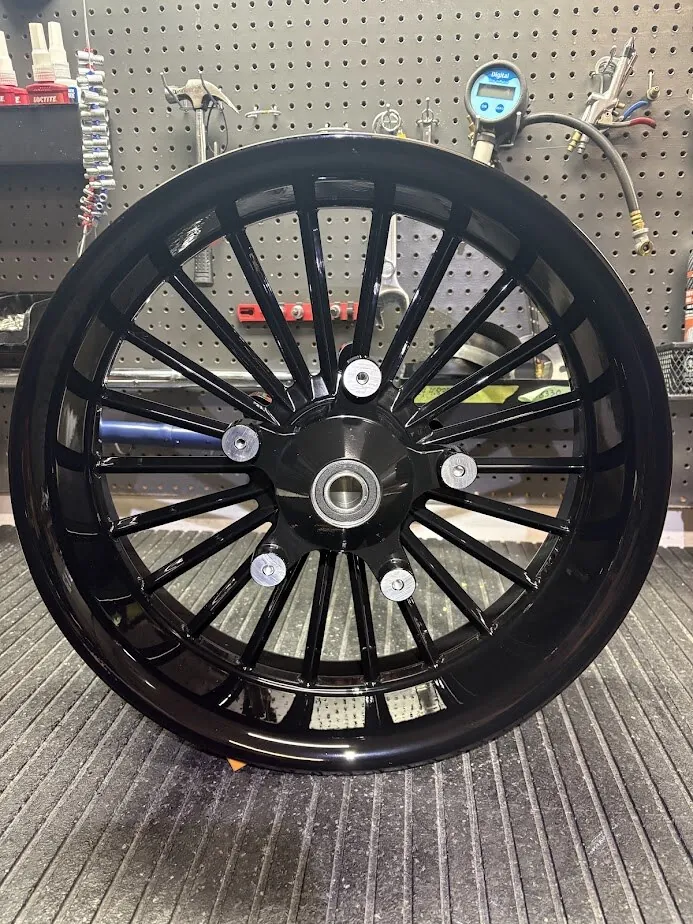
Can you always tell which side of the ABS bearing goes out? Usually, there is a groove around the bearing at one end. That groove goes to the bottom. The sensor side is usually a gold colour that is unmistakable. However, we have had a batch of ABS bearings that have a gray encoder, as on the Havoc Diamond 18x5.5 Wheel in the next picture. The light gray is different than the black dust seal, so that is a clear tell. If you are ever unsure, there is an easy test. You can purchase a Magnetic Viewing Film on Amazon for about $5.
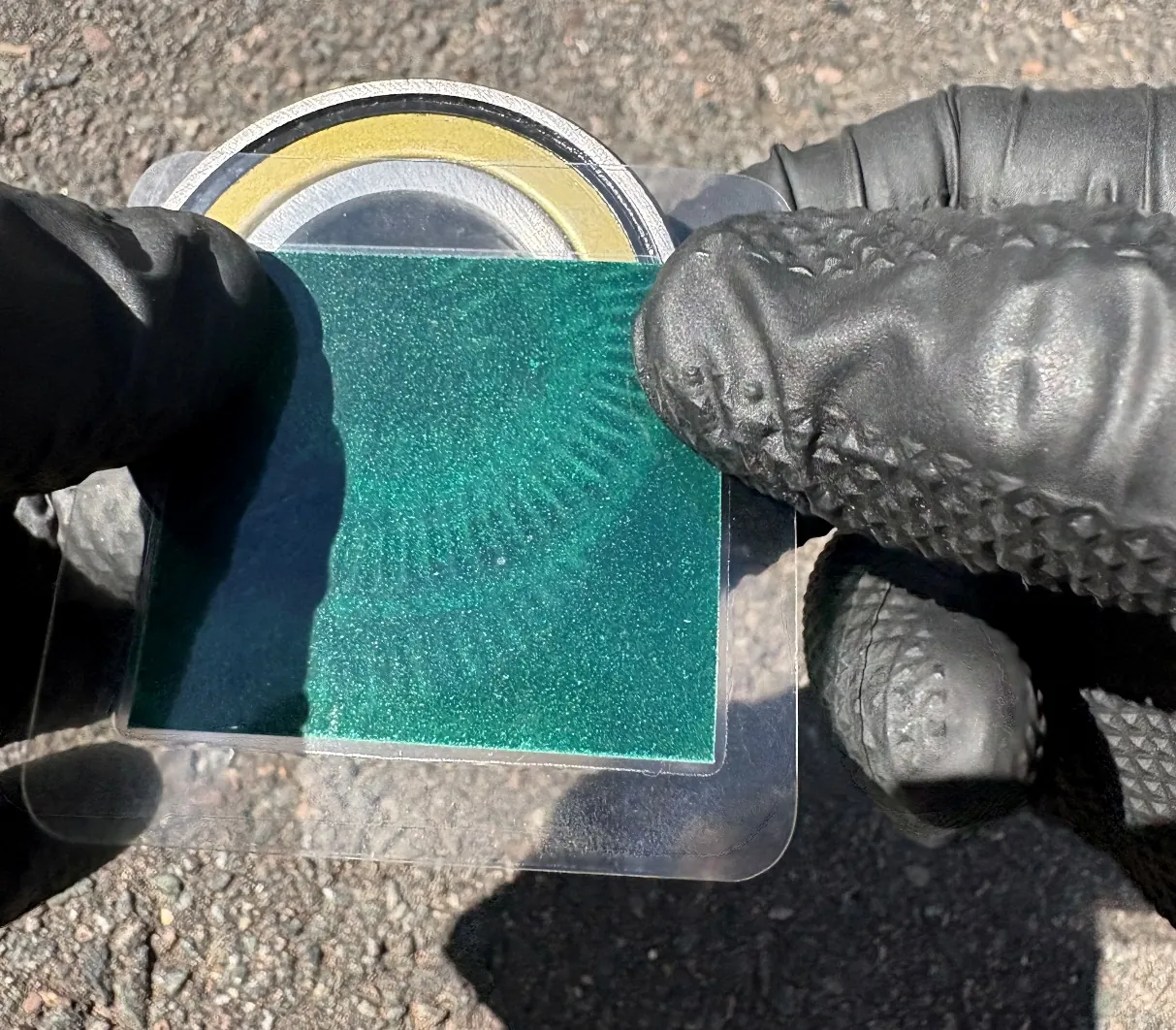
Magnetic viewing film is a thin, flexible plastic sheet, usually about the size of a business card, that shows you a magnetic field you can't otherwise see. Inside it are microscopic nickel flakes suspended in tiny oil-filled capsules, and the flakes are free to turn and line up with any magnetic field nearby.
How it shows the field:
- Over a magnetic pole, the field runs straight through the film. The flakes stand on edge and that area looks dark.
- Between two poles, the field runs flat along the film. The flakes lie down, reflect light, and that area looks bright.
Why it works on an ABS bearing: the encoder in an ABS wheel bearing is a magnetised ring with alternating north and south poles all the way around. The wheel speed sensor counts those poles going past to work out wheel speed. Lay the film on the encoder side and you see a ring of evenly spaced light and dark stripes, a bit like a barcode bent into a circle. Lay it on the other side and you see nothing. That tells you at once which face is the encoder, whatever colour the seal is.
It also does two more jobs:
- Finds a damaged encoder. Stripes that are missing, smeared or uneven mean a damaged or partly demagnetised encoder. That's a common cause of an ABS light that won't go out even when the bearing is in the right way round.
- Costs almost nothing to use. It needs no power and lasts indefinitely, so it's cheap to keep in the toolbox.
ABS light on after installing new wheels?
If the ABS light stays on after a wheel change, the system is not getting a good wheel-speed signal from one of the wheels. After a wheel change, the cause is nearly always one of these:
- The ABS bearing is on the wrong side. On the front wheel it belongs on the left, next to the sensor. On a dual-disc wheel this is the easiest mistake to make, and the reason the valve stem check above matters.
- The ABS bearing is facing the wrong way. The encoder is on one face of the bearing, and that face must point outward, toward the sensor. A bearing pressed in back to front will not be read. The encoder face is very often gold, but not always; some are gray, so the color is not a reliable guide. The sure way to find it is with magnetic viewing film: laid against the bearing, it shows the encoder's magnetic pattern on one face and nothing on the other. Check before the bearing is pressed in.
- The wrong bearing. A standard bearing has no encoder at all. An ABS bearing that is not matched to the wheel's diameter gives a speed reading that disagrees with the other wheel, and the system will flag it.
- The sensor is not seated. The wheel speed sensor has to sit at the correct gap from the encoder. Make sure it is fully seated and its fastener is tight, and that the spacer or sensor bracket is in the position the service manual shows.
- Debris on the sensor or encoder. The sensor is magnetic and picks up metal filings and grit, which weaken the signal. Clean the sensor tip and the encoder face before reassembly.
- A damaged wire or connector. The sensor lead is easily snagged or pinched when a wheel comes out. Check its routing and its connector.
Once the cause is corrected, the light should go out on the next ride. If a fault code was stored while the problem existed, it may need to be cleared by a dealer or with a diagnostic tool. The best way to avoid all of this is to confirm the ABS bearing's side and direction at the dry-fit stage, before the tire is mounted.
Rear tires on the front
Our 180mm fat front tire kits, like most fat front conversions, have traditionally used a tire designed as a rear tire. When a rear tire is used on the front of a motorcycle, it is mounted backwards, so that the rotation arrow points toward the back of the motorcycle. This is not a mistake. A rear tire's construction is built to carry acceleration forces, and on the front of the motorcycle the dominant force is braking, which acts in the opposite direction. Reversing the tire aligns its construction with the forces it will actually carry.
The market has caught up with the fat front. Tire makers now offer 180/55-18 tires designed specifically for front fitment, including the Metzeler ME888 and the Avon Cobra. They mount in the normal direction, with the arrow pointing forward, and they are an excellent choice for a fat front kit. We also still like the Dunlop Sportmax D207, a radial rear tire that, mounted reversed on the front, gives the fat front a precise, planted feel. It is our preferred choice for riders who want the sharpest handling from the conversion.
With a reversed rear tire on an ABS motorcycle, there is only one way to install the wheel — with the ABS bearing on the left — and you will notice that the rotation arrow points toward the back of the motorcycle. On a non-ABS motorcycle, there are two possible orientations, so be sure the arrow points toward the back.
Some tires are bi-directional, like the Pirelli Night Dragon, designed for use on either the front or the rear. These are marked with separate arrows labeled F and R. Mount the tire so the F arrow points in the direction of forward travel.
Before the tire is mounted
The best time to settle direction is before the tire goes on — ideally at the dry-fit stage, when you have confirmed which side the ABS bearing and the rotors belong on. Once the tire is mounted, the wheel's orientation is fixed by the arrow. Get it right on the bench, and the wheel goes into the forks one way only.