
Every custom wheel conversation eventually comes down to numbers stamped on a sidewall: 130/60-19, 180/55-18, 120/70-21. Learn to read them and you can work out, on the back of an envelope, whether a wheel-and-tire combination will fit your motorcycle — and why some upgrades are bolt-on while others need a new triple tree.
The rim: diameter x width
Rim sizes are given as diameter by width, in inches. A 19 x 3 rim is 19 inches in diameter at the bead seat and 3 inches wide between the bead flanges. An 18 x 5.5 is 18 inches in diameter and 5.5 inches wide.
Width matters as much as diameter. Every tire is designed to be mounted on a range of rim widths, and the tire manufacturer publishes that range. Mount a tire on a rim that is too narrow and the tread is pinched into a pointed profile; too wide and the profile is flattened. Either one changes how the motorcycle steers and leans. When we specify a wheel and tire together, the rim width is chosen to suit the tire.
The tire: width, aspect ratio, rim diameter
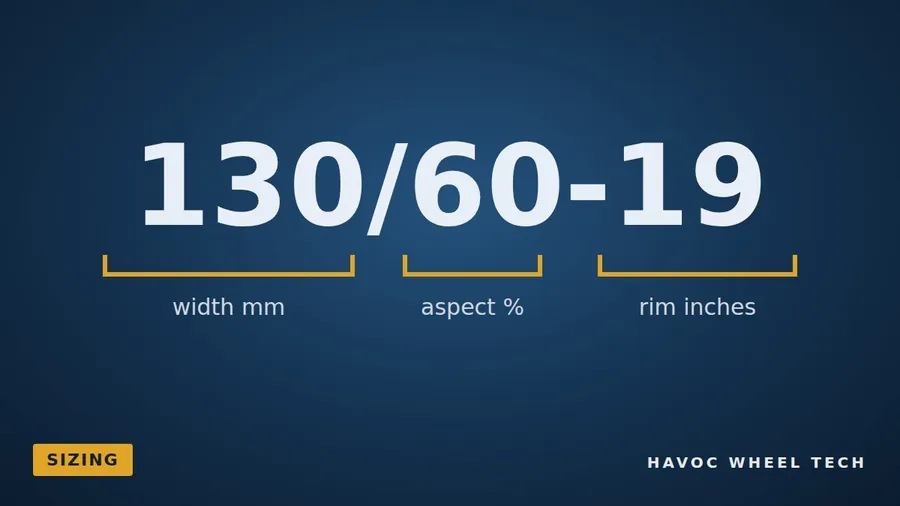
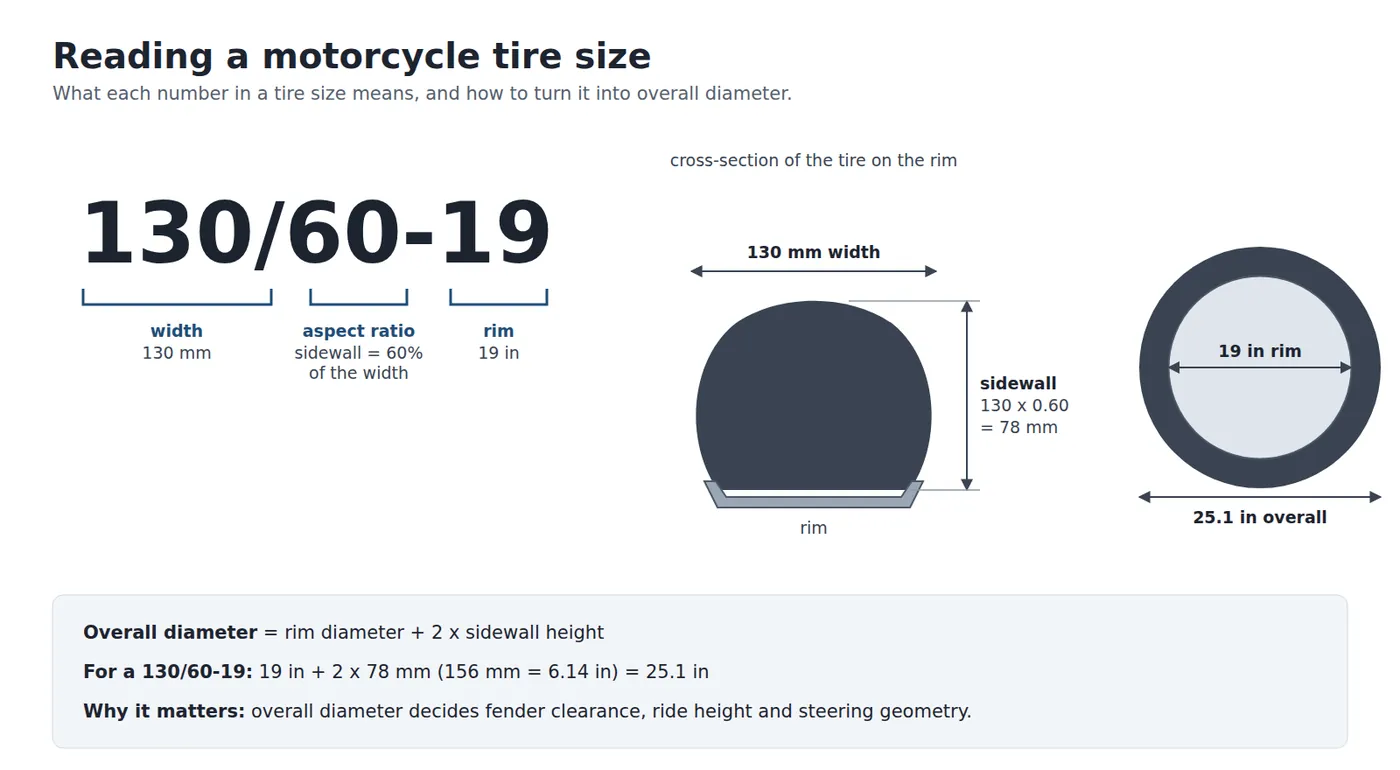
A metric motorcycle tire size looks like this: 130/60-19. It contains three numbers:
- 130 is the nominal section width of the tire in millimetres — its width at the widest point of the sidewall when mounted on the specified rim.
- 60 is the aspect ratio: the sidewall height as a percentage of the width. Here the sidewall is 60 percent of 130mm, or 78mm tall.
- 19 is the rim diameter in inches that the tire fits.
You will often see a letter in place of the hyphen, as in 130/60B19 or 180/55ZR18. The letter indicates construction: B for bias-belted, R for radial, and a hyphen or no letter usually for conventional bias-ply. Some sizes also carry a speed-rating letter in this position. Radial and bias-ply tires can be paired front and rear, but they behave differently, so choose a combination the tire manufacturer lists as approved in its fitment guide.
Calculating overall diameter
The single most useful calculation in wheel fitment is a tire's overall diameter. It tells you how tall the wheel and tire will stand, which determines fender clearance, whether the steering geometry changes, and whether a raked triple tree is needed.
The formula is straightforward:
Overall diameter = rim diameter + 2 x (width x aspect ratio) , with the sidewall converted from millimetres to inches (divide by 25.4).
For a 130/60-19: the sidewall is 130 x 0.60 = 78mm. Two sidewalls are 156mm, or 6.14 inches. Add the 19-inch rim, and the nominal overall diameter is about 25.1 inches.
Run the same calculation for the factory Touring front sizes and something useful emerges:
| Tire size | Sidewall height | Nominal overall diameter |
|---|---|---|
| 130/90-16 | 117 mm | 25.2 in |
| 130/80-17 | 104 mm | 25.2 in |
| 130/70-18 | 91 mm | 25.2 in |
| 130/60-19 | 78 mm | 25.1 in |
| 120/70-21 | 84 mm | 27.6 in |
| 180/65-16 | 117 mm | 25.2 in |
| 180/55-18 | 99 mm | 25.8 in |
| 200/50-18 | 100 mm | 25.9 in |
| 130/60-23 | 78 mm | 29.1 in |
The first four sizes are the factory Touring fronts from 16 to 19 inches, and they are the same height to within a tenth of an inch. That is the essence of plus-sizing: as the rim gets bigger, the sidewall gets shorter, and the overall diameter stays put. The motorcycle's geometry, ground clearance and fender clearance do not change.
Now look at the 120/70-21. It stands about 2.4 inches taller than the stock fronts, which raises the front of the motorcycle by about 1.2 inches at the axle and needs more fender clearance. That is why a 21-inch front, even when it bolts into the forks, needs a fender lift bracket or a larger fender. And the 130/60-23 is nearly 4 inches taller than stock — far beyond what the stock geometry can accept, which is why 23-inch fronts require a raked triple tree. For worked examples of how a change in diameter affects stance and clearance, see Sizing and Fitment: Front vs Rear, 16, 18 and 21 Explained; for what the larger sizes do to steering geometry, see Rake, Trail and Raked Triple Trees.
Nominal versus actual
These are nominal figures. Real tires differ from the formula, sometimes by a few tenths of an inch, and the same size can measure differently from one manufacturer to another or on a different rim width. Tires also grow slightly with inflation and at speed. Use the calculation to compare options and understand why a combination does or does not fit; use the tire manufacturer's published dimensions, and a physical check on the motorcycle, to confirm clearance.
This is exactly how we specify our 180mm fat front tire kits: the replacement tire must not exceed 25.8 inches in overall diameter or 7.25 inches in mounted width on an 18 x 5.5 wheel. The 25.8-inch figure is precisely the nominal diameter of a 180/55-18, and it is the practical limit of what clears the fork and fender.
Other markings worth knowing
- TL and TT. TL means tubeless; TT means tube type. A tire marked TL can run without a tube on a wheel designed for tubeless use. Some tires are marked for both. (See Tubes, Tubeless and Balancing.)
- Rotation arrow. Most motorcycle tires are directional, and an arrow on the sidewall shows the direction of rotation. Some tires carry separate arrows for front and rear use. Some are bi-directional. (See Which Way Does the Wheel Go?)
- Load index and speed rating. A number and letter such as 72H give the maximum load per tire and maximum sustained speed. Touring motorcycles are heavy, especially two-up with luggage, so never fit a tire with a lower load index than the factory specification.
- Date code. The last four digits of the DOT code give the week and year of manufacture — 2324 means the 23rd week of 2024. Rubber ages whether or not it is ridden on, so check the date on any tire before you mount it.