
A big front wheel is the most dramatic change you can make to a bagger. It is also the one that changes the way the motorcycle steers. The reason is geometry, specifically two numbers called rake and trail, and the fix, when one is needed, is a raked triple tree and, for the largest wheels, a raked neck.
This article explains rake and trail from first principles, calculates exactly what each popular big-wheel size does to them on a Harley-Davidson Touring motorcycle, and shows how raked trees and frame rake bring the geometry back to where it belongs. The short version:
- A 21 x 3.5 front changes the geometry only slightly. It needs a fender solution, but not new trees.
- A 23 x 3.5 or a 21 x 5.5 fat front stands about 3 to 4 inches taller than stock. Raked triple trees are needed to pull the trail back.
- A 23 x 5.5 or a 26 x 3.5 stands about 5 to 5.5 inches taller than stock. Raked trees pull the trail back, but raked trees alone leave the front of the motorcycle standing tall. Raking the neck as well brings the chassis back down. But a raked frame neck also adds more trail, so the components must be designed to work together. In other words, the raked trees are compensating for two things at once: the trail added by the taller wheel, and the trail added by the raked neck. That is why the tree rake has to increase as the neck rake does.
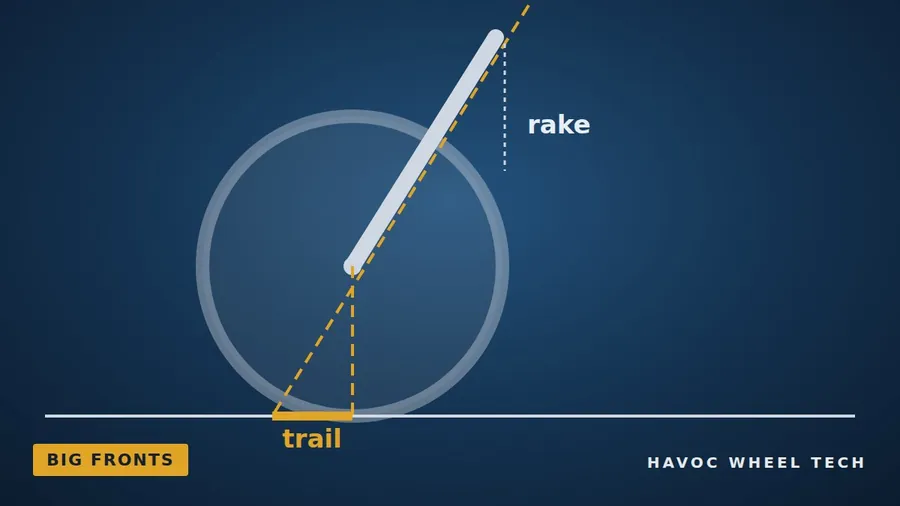
What rake is
Rake is the angle of the motorcycle's steering axis, measured from vertical. The steering axis is the line through the neck (the steering head) about which the whole front end turns. A larger rake angle means a more laid-back front end.
On a Harley-Davidson, two angles matter, and Harley's specifications list both:
- Rake (steering head): the angle of the neck itself. On current Touring models this is 26°.
- Fork angle: the angle of the fork tubes. On current Touring models this is 29.25°.
The difference, 3.25°, is built into the triple trees. In other words, the factory trees are already raked: the fork tubes sit at a slightly steeper lay-back than the neck. Aftermarket raked trees simply increase that difference.
What trail is
Trail is the distance on the ground between two points: where the steering axis meets the road, and where the tire actually touches the road (directly below the axle). On a motorcycle, the steering axis meets the road ahead of the tire's contact patch, so the tire "trails" behind it, like the caster wheel on a shopping cart.
Trail is what makes a motorcycle want to run straight. Because the contact patch trails behind the steering axis, any deflection of the front wheel creates a force that pulls it back into line. More trail means more of that self-centering force:
- More trail gives more straight-line stability and a calmer feel at speed, but heavier steering, slower turn-in and more effort at parking-lot speeds.
- Less trail gives lighter, quicker steering, but less stability. Too little, and the motorcycle can feel nervous.
Harley-Davidson sets current Touring models at about 6.8 to 6.9 inches of trail. That is the reference point for everything below.
What controls trail
Trail is set by three things:
- The tire radius (R): the distance from the axle to the ground, which is half the tire's overall diameter.
- The steering angle (rake, θ).
- The offset: how far the front axle sits ahead of the steering axis, measured at right angles to it. The triple trees set most of this.
The relationship is:
Trail = (R × sin θ − offset) ÷ cos θ
Two things follow directly from it. A larger tire radius increases trail. A larger rake angle increases trail. The only thing in the equation that reduces trail is more offset: moving the front axle further ahead of the steering axis. That is exactly what raked triple trees do.
What a bigger front wheel does to trail
A taller front wheel increases trail in two ways at once.
First, the tire radius goes up, and trail goes up with it.
Second, the taller wheel lifts the front of the motorcycle. Only half of the diameter increase lifts the axle (the other half is above it), but even so, a 26-inch front raises the front axle by nearly 3 inches. With the rear of the motorcycle unchanged, that tips the whole chassis back slightly, which increases the rake angle, which increases trail again.
The table below calculates both effects for the popular big-wheel sizes on a current Touring chassis with stock triple trees. The overall diameters are nominal figures calculated from the tire size. (For how to calculate them, see How to Read Motorcycle Tire and Rim Sizes.)
| Front tire | Rim | Overall diameter | Axle rise | Steering head angle | Trail | Change |
|---|---|---|---|---|---|---|
| 130/60-19 (stock) | 19 x 3 | 25.14 in | — | 26.0° | 6.80 in | — |
| 130/60-21 | 21 x 3.5 | 27.14 in | 1.00 in | 26.9° | 7.56 in | +0.76 in |
| 180/50-21 | 21 x 5.5 | 28.09 in | 1.47 in | 27.3° | 7.93 in | +1.13 in |
| 130/60-23 | 23 x 3.5 | 29.14 in | 2.00 in | 27.8° | 8.36 in | +1.56 in |
| 180/50-23 | 23 x 5.5 | 30.09 in | 2.47 in | 28.2° | 8.75 in | +1.95 in |
| 120/50-26 | 26 x 3.5 | 30.72 in | 2.79 in | 28.5° | 9.03 in | +2.23 in |
The sizes fall naturally into three groups.
The 21 x 3.5. A 130/60-21 adds about three-quarters of an inch of trail. That is noticeable: the motorcycle feels a little more stable and deliberate and takes a little more effort to turn in. But it is well within what the stock chassis handles comfortably, so a 21 x 3.5 needs no change to the trees. (For more on what a 21-inch front changes, see Sizing and Fitment: Front vs Rear, 16, 18 and 21 Explained.)
The 23 x 3.5 and the 21 x 5.5. These two look very different, one tall and narrow and the other short and wide, but their overall diameters are close: about 29.1 and 28.1 inches. Both add well over an inch of trail, enough to make the steering noticeably heavy and slow. They need the same solution, and the same triple tree.
The 23 x 5.5 and the 26 x 3.5. Again, two very different looks with almost the same overall diameter: about 30.1 and 30.7 inches, within two-thirds of an inch of each other. Both add around 2 inches of trail and lift the front axle by about 2.5 to 2.8 inches.
26-inch front wheels are made in both 3.5-inch and 3.75-inch widths, depending on the manufacturer. The 120/50-26 tire is approved for both, and the overall diameter is the same, so the figures in this article apply to either width.
What raked triple trees do
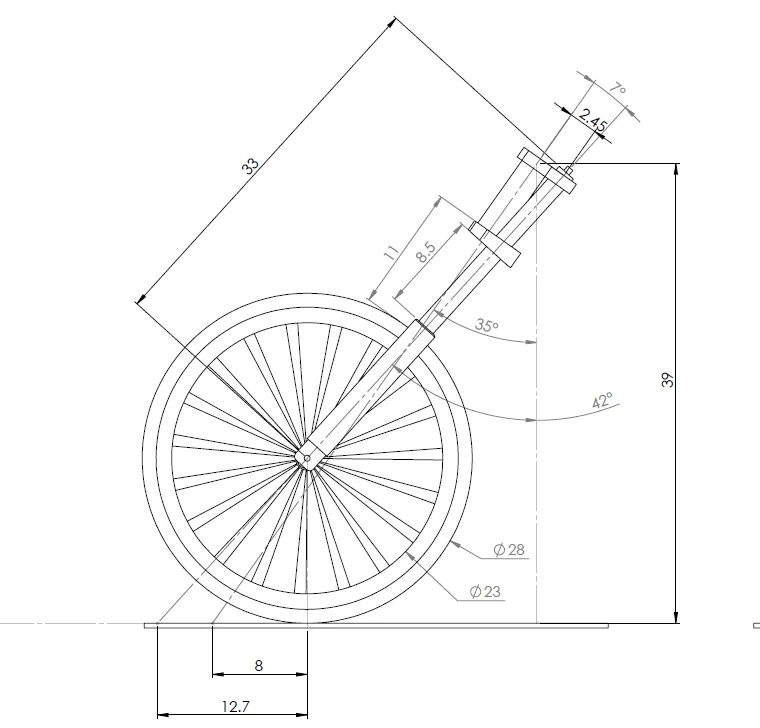
A raked triple tree increases the angle of the fork tubes relative to the neck. Swinging the lower end of the fork forward moves the front axle further ahead of the steering axis. That increases the offset in the trail equation, and it is the one change that reduces trail. It also drops the front of the motorcycle slightly, because a more laid-back fork holds the axle a little higher relative to the frame.
Raked trees are specific to the front end they fit. Harley-Davidson moved the Touring models from 41mm to 49mm fork tubes in 2014, so trees are made separately for 2013-and-earlier and 2014-and-later models.
The 23 x 3.5 and 21 x 5.5: raked trees are enough
For the first group, raked trees alone restore the geometry. Using the same Touring chassis as the table above, the tree rake needed to return trail to the stock 6.8 inches works out as follows:
| Front tire | Rim | Total tree rake needed | Added over stock trees | Remaining front rise |
|---|---|---|---|---|
| 180/50-21 | 21 x 5.5 | 5.0° | +1.7° | about 1.0 in |
| 130/60-23 | 23 x 3.5 | 5.6° | +2.3° | about 1.4 in |
Two points stand out. The tree rake required for the two wheels is similar, which is why they share a tree. And once the trail is corrected, the front of the motorcycle sits only about an inch higher than stock. That is a stance change most riders are happy with, and many prefer it.
The 23 x 5.5 and 26 x 3.5: raked trees plus frame rake
For the second group, raked trees can still pull the trail back, but they cannot bring the motorcycle back down:
| Front tire | Rim | Total tree rake needed | Added over stock trees | Remaining front rise |
|---|---|---|---|---|
| 180/50-23 | 23 x 5.5 | 6.2° | +2.9° | about 1.7 in |
| 120/50-26 | 26 x 3.5 | 6.6° | +3.3° | about 1.9 in |
With trees alone, the front of the motorcycle still stands close to 2 inches high. The whole chassis sits nose-up, the steering head is steeper than designed, and the motorcycle looks and rides like what it is: a bike with a wheel that is too tall for it.
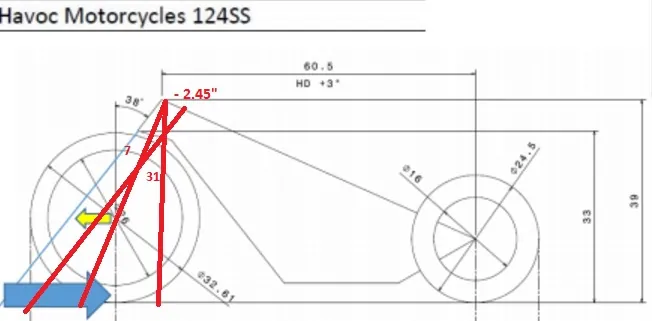
This is where frame rake comes in. Raking the neck, meaning changing the angle of the steering head itself, lays the whole front end back and brings the front of the motorcycle down. On its own, frame rake would increase trail, because it increases the rake angle in the trail equation. So the two changes work together: frame rake restores the stance, and the raked trees, now with more rake, restore the trail.
| Front tire | Neck raked by | Total tree rake needed | Remaining front rise |
|---|---|---|---|
| 180/50-23 | 2° | 6.9° | about 1.0 in |
| 180/50-23 | 3° | 7.3° | about 0.6 in |
| 180/50-23 | 5° | 8.0° | level with stock |
| 120/50-26 | 2° | 7.3° | about 1.2 in |
| 120/50-26 | 3° | 7.7° | about 0.8 in |
| 120/50-26 | 5° | 8.4° | level with stock |
Every combination in this table returns trail to the stock 6.8 inches. The difference is how the motorcycle sits. With about 5° of neck rake and 8° or so in the trees, a 23 x 5.5 or 26 x 3.5 sits level, at stock stance, with stock trail, on a wheel more than 5 inches taller than the one it came with.
At a glance: what each front wheel needs
| Front wheel | Typical tire | Overall diameter | Triple trees | Frame (neck) rake |
|---|---|---|---|---|
| 21 x 3.5 | 130/60-21 or 120/70-21 | 27.1–27.6 in | Stock | Stock |
| 21 x 5.5 | 180/50-21 | 28.1 in | Raked | Stock |
| 23 x 3.5 | 130/60-23 | 29.1 in | Raked | Stock |
| 23 x 5.5 | 180/50-23 | 30.1 in | Raked | Raked |
| 26 x 3.5 | 120/50-26 | 30.7 in | Raked | Raked |
The rest of the job
Geometry is the heart of a big-wheel conversion, but it is not the whole of it. Every size above 21 x 3.5 also needs a fender designed for the wheel, because a stock fender cannot be lifted far enough. Any raked front end changes the angle of the headlight or fairing, which must be corrected. On ABS motorcycles, the brake lines must be rerouted across the lower tree, and the ABS setup must suit the larger wheel diameter. And tire choice matters: a tire's profile affects steering feel as much as a fraction of an inch of trail, so two motorcycles with the same geometry can still steer differently. (See Going Bigger Up Front.)
Frame rake is a structural change to the motorcycle's frame, and raked trees change its steering geometry. Both are jobs for a builder with the experience and equipment to do them properly. Talk to us before you commit to a wheel size, and we will tell you exactly what your motorcycle needs.
How these figures were calculated
The figures in this article use Harley-Davidson's published geometry for a current Touring model: 26° steering head, 29.25° fork angle, 6.8 inches of trail and a 64-inch wheelbase, on a 130/60-19 front tire. Tire diameters are nominal, calculated from the tire size; real tires vary by a few tenths of an inch between brands and models. The raked-tree calculations assume a representative fork length of 30 inches with the tree's neck offset held at stock, and they treat the rear of the motorcycle as fixed. Real tree designs combine rake and offset in different ways, so the exact figures for any particular kit will differ. The pattern will not: a larger wheel adds trail, raked trees take it away, and frame rake brings the motorcycle back down.