
If you ride an Evolution-era Harley-Davidson built before the 2000 model year, you will find that almost every wheel on the market today is designed for the later motorcycles. Wheels built for the older tapered-bearing system are, to all intents and purposes, no longer made. That does not mean you cannot fit a modern wheel to an older bike. It does mean the conversion involves more than the wheel.
What changed in 2000
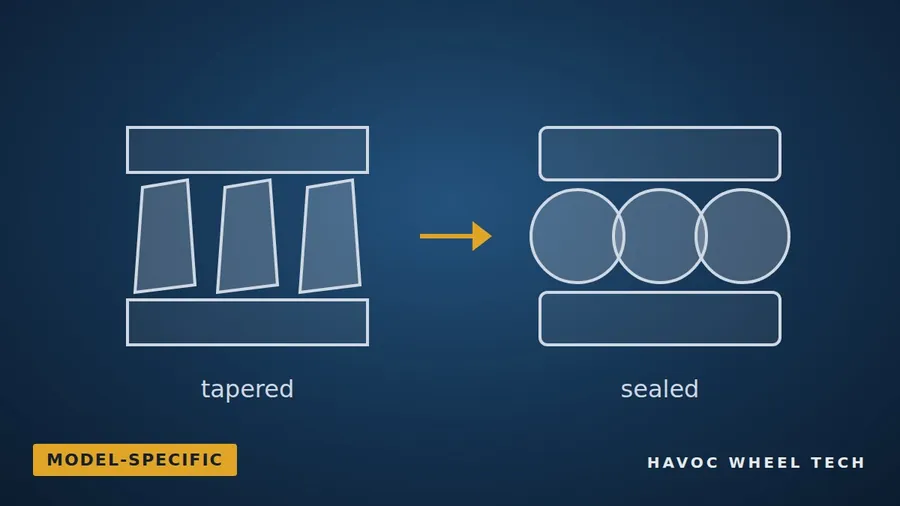
Up to the 1999 model year, Harley-Davidson wheels used tapered roller bearings running in pressed-in races. Tapered bearings are adjustable: they are set up with a specific amount of end play, which is achieved with shims. Because of manufacturing variation, the bearings in each hub seated at slightly different depths, and the correct end play was reached by selecting shims from a wide range of thicknesses.
From the 2000 model year, Harley-Davidson moved to sealed cartridge bearings. A sealed bearing is not adjustable; it presses into a machined bore in the hub and seats at a fixed depth, every time. The spacing between the bearings, and between the bearings and the fork legs or swingarm, is controlled entirely by the spacers. There are no shims.
The two systems are not interchangeable piece by piece. The spacers and shims from a tapered-bearing motorcycle were chosen to suit the way its bearings seated. Put a modern sealed-bearing wheel between them and the spacing will almost certainly be wrong.
Softail models
On Softails, the 3/4-inch axle diameter was carried over when the bearings changed, so a 2000-or-later style wheel can be used on an earlier Softail with the right supporting parts:
- Use 2000–2006 Softail axle spacers, in place of the original tapered-bearing spacers and shims.
- Use 2000-and-later brake rotors. Earlier rotors will not fit the later-style wheels.
- If you are fitting a rear wheel, the rotor and pulley mounting also changed in 2000, so you will need these components as well. See Rear Pulley Spacers and Belt Alignment for the options.
As always, check that the axle itself is in serviceable condition — straight, unworn and free of corrosion — before reusing it.
Touring models
Touring models are a different story. When Harley-Davidson changed from tapered to sealed bearings on the Touring bikes, it also changed the axle diameter from 3/4 inch to 1 inch. A later wheel therefore cannot simply be dropped into an earlier Touring chassis with a different set of factory spacers, because no factory combination of parts exists for that mix. Converting a pre-2000 Touring motorcycle to modern wheels requires custom-made axle spacers, designed for your specific wheel and chassis.
This is exactly the kind of installation where a shop with custom experience and the ability to measure and machine is essential. If you have a pre-2000 Touring motorcycle, call us before ordering, and we will talk through the options for your bike.
Why there are no shortcuts
It can be tempting to think that "close enough" spacing will do on an old bike. It will not. Incorrect spacing either pre-loads the sealed bearings sideways when the axle is torqued — shortening their life dramatically and making the wheel hard to turn — or leaves the wheel free to shift, which moves the rotor off-center in the caliper and can upset handling. Correct spacing is what allows the axle to be torqued fully while the wheel still spins freely and runs true.