
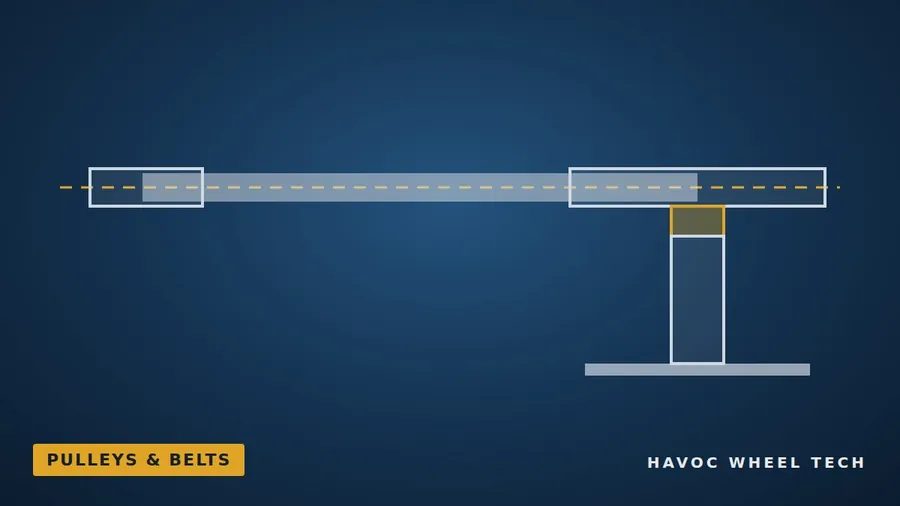
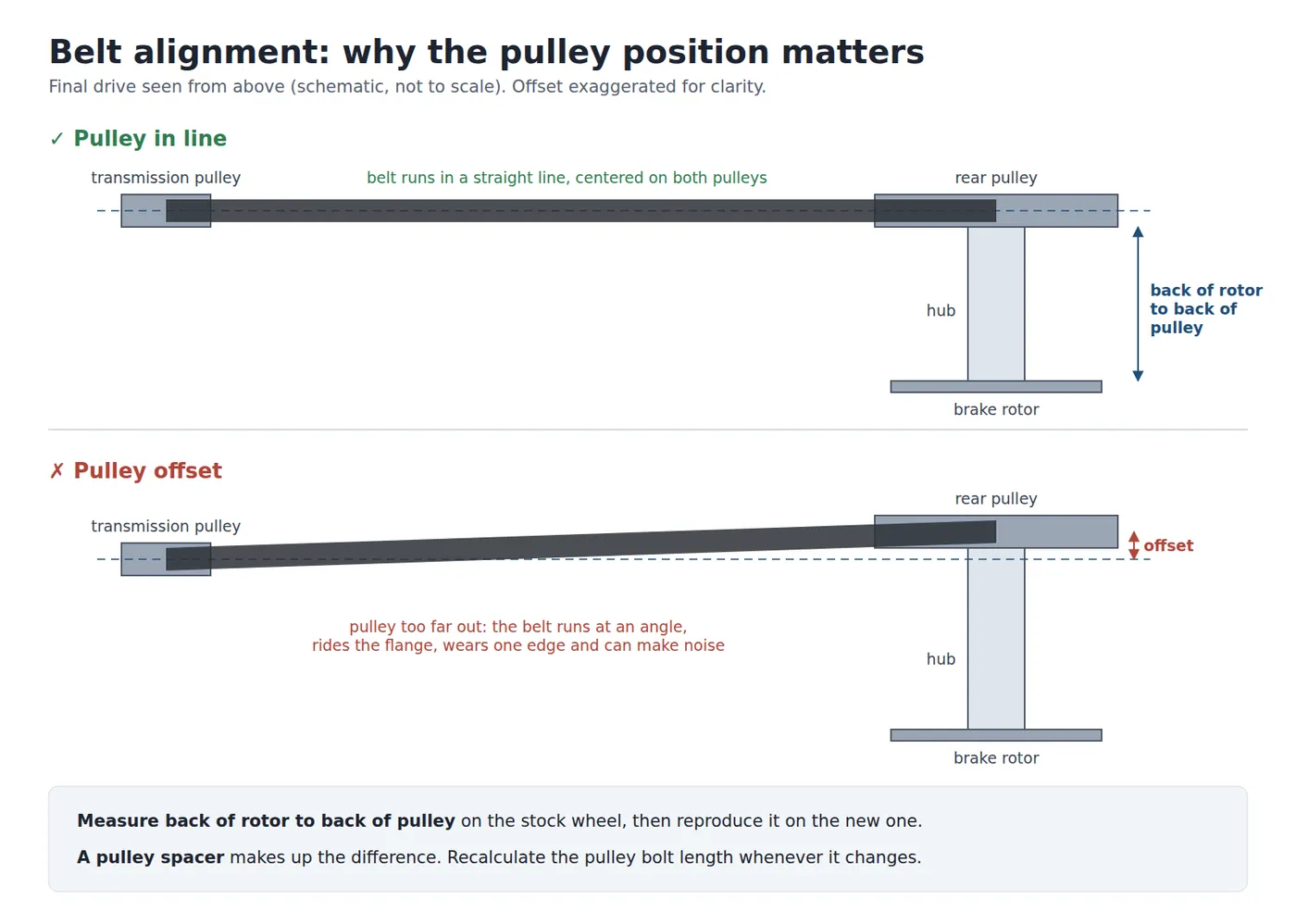
A belt-drive Harley-Davidson is unforgiving about alignment. The final drive belt has to run in a straight line from the transmission pulley to the rear wheel pulley. If the rear pulley sits even a fraction of an inch too far in or out, the belt runs at an angle. It rides against the pulley flange, wears on one edge, can make noise, and in the worst case contacts the tire, the swingarm or the belt guard. The pulley spacer exists to prevent that.
What a pulley spacer does
On a stock wheel, the pulley mounts directly to the hub, and the hub is designed so the pulley lands exactly in line with the transmission pulley. A pulley may also be a different shape from stock: flat-backed or dished, thicker or thinner at the mounting face.
A pulley spacer is a precision-machined ring that sits between the hub and the pulley and moves the pulley outboard by exactly the right amount. Most have a locating ring, or spigot, that centers the pulley on the spacer, and the spacer on the hub. The pulley bolts pass through the pulley and the spacer into the hub, which is why the bolt length must be recalculated whenever a spacer is added or changed (see Pulley Bolts and Aluminum Hubs).
The reference measurement
The most useful measurement for rear-wheel pulley fitment is the distance from the back of the brake rotor to the back of the pulley — that is, between the two mounting faces. That dimension is set by the motorcycle, not the wheel: it is what the chassis needs for the rotor to sit in the caliper and the pulley to line up with the belt. Measure it on the stock wheel, then make sure the custom wheel, with its pulley and any spacer, reproduces it.
Some reference figures from motorcycles we have measured:
| Model | Back of rotor to back of stock pulley |
|---|---|
| 2007–2013 Softail | 7.0 in |
| 2013–2017 Heritage Softail | 7-1/8 in |
| 2018–2020 Softail | 7.0 in |
These figures illustrate the method; they are not a substitute for measuring your own motorcycle. Production variation, previous modifications and different pulleys all change the answer.
Softail examples
The spacer a given installation needs depends on three things: the motorcycle, the wheel and the pulley. Some examples from our own experience with Softail models:
- 2005 Softail with the stock pulley: no pulley spacer required.
- 2005 Softail with an aftermarket pulley: 1/2-inch pulley spacer.
- 2007 and later Softail with the stock pulley: 1/2-inch pulley spacer. For our Fat Spoke wheels, the 2007-and-later Softail pulley installation kit consists of a 1/2-inch pulley spacer plus a 1/2-inch axle spacer on the drive side. Do not forget the axle spacer — without it, the wheel will not sit in the correct position in the swingarm.
- 2007 and later Softail with an aftermarket pulley: depending on the design of the pulley, the spacer can be 3/4 inch to 7/8 inch, with correspondingly longer pulley bolts (2-1/4 inch with washers, in the installations we have done).
- 2013–2017 Heritage Softail: a flat-backed pulley with a 3/4-inch spacer reproduces the stock 7-1/8-inch rotor-to-pulley dimension exactly.
- 2018–2020 Softail: with our Fat Spoke wheels, a 5/8-inch pulley spacer, plus the 1/2-inch drive-side axle spacer.
The lesson of that list is that the spacer is not a property of the motorcycle alone. Change the pulley and the spacer changes. That is why the rotor-to-pulley measurement, and a dry fit before the tire is mounted, matter so much.
Using a 1999-or-earlier pulley on a 2000-or-later wheel
Harley-Davidson changed the pulley mounting design for the 2000 model year. The pulley on a 1999-or-earlier motorcycle locates on a smaller diameter than the pulley on a 2000-or-later wheel:
| Wheel | Pulley locating diameter |
|---|---|
| 1999 and earlier | 1.986 in |
| 2000 and later | 2.208 in |
There are two ways to fit an earlier pulley to a later-style wheel.
A pulley adapter. An adapter spacer centers the older pulley on the newer hub. Because it needs a locating flange on both sides, the thinnest practical adapter is 1/4 inch thick. That quarter inch moves the pulley outboard, so you must check belt alignment carefully to be sure the belt runs true and does not contact anything between the rear pulley and the front pulley. You must also use longer pulley bolts to compensate for the adapter, without letting them bottom in the hub.
Machining the pulley. If a 1/4-inch adapter moves the pulley too far out for your application, the alternative is to machine the center bore of the pulley from 1.986 inches to 2.208 inches, so it locates directly on the later-style hub. This is a job for a competent machine shop: the bore must be concentric with the pulley teeth, or the pulley will run out of true.
How to check belt alignment
With the wheel installed and the axle adjusted according to the service manual:
- Rotate the rear wheel slowly by hand and watch the belt where it enters and leaves the rear pulley. It should run centered on the pulley teeth and should not climb toward or rub against either pulley flange.
- Look along the belt from behind the motorcycle. It should run in a straight line between the two pulleys.
- Check the clearance between the belt and the tire, the swingarm, the belt guard and any other nearby part, all the way around.
- Set belt tension to the service manual specification for your model — too tight or too loose will both shorten belt life.
Finally, ride the motorcycle a short distance and re-check. A belt that is migrating toward one flange is telling you the alignment is not right.
Belt noise or a belt tracking to one side after a wheel change
A belt that chirps, whines or rides hard against one flange after new wheels go on is almost always telling you something specific, and it is usually quick to put right. Work through these in order:
- Rear axle alignment. When the rear wheel comes out, the axle adjusters on each side are often disturbed. If one side is set further back than the other, the rear pulley is angled to the belt, and the belt walks toward one flange. Check alignment with an axle alignment tool, measuring from the swingarm pivot to the axle on both sides, and set it according to the service manual. This is the most common cause, and the first thing to check.
- Pulley position. If the axle is straight but the belt still rides against a flange, the pulley is sitting too far in or out. Re-check the back-of-rotor to back-of-pulley measurement described above, and the pulley spacer.
- Pulley seating. A pulley must sit flat on its spacer and the spacer flat on the hub. A burr, a paint edge or debris on a mounting face will make the pulley wobble as it turns, which you can see by watching the pulley flange as the wheel rotates. Remove it, clean the faces and reinstall it with new bolts (see Pulley Bolts and Aluminum Hubs).
- Belt tension. Set it to the service manual specification for your model. A belt that is too tight whines and loads the bearings; one that is too loose can slap and jump.
- The belt itself. A drive belt must never be kinked, twisted, folded tightly or levered over a pulley flange during a wheel change. Doing so can damage the internal cords, and a damaged belt may never track properly again. Inspect it for cuts, stone damage and worn teeth while the wheel is out.
Stock rear pulley, belt and rotor sizes: Touring and Softail
Before you change or replace a rear pulley, it helps to know what your motorcycle came with. The table below lists the stock rear pulley tooth count, belt width, belt length (in teeth) and rotor diameters for 2000-and-later Touring and Softail models.
| Model | Years | Rear pulley | Belt width | Belt length | Front rotor | Rear rotor |
|---|---|---|---|---|---|---|
| Touring, all models | 2000–2003 | 70 tooth | 1.5 in | 139 tooth | 11.5 in | 11.5 in |
| Touring, all models | 2004–2006 | 70 tooth | 1.125 in | 139 tooth | 11.5 in | 11.5 in |
| Touring, all models | 2007 | 66 tooth | 1 in | 137 tooth | 11.5 in | 11.5 in |
| Touring, all models | 2008 | 66 tooth | 1 in | 137 tooth | 11.8 in | 11.8 in |
| Touring, all models | 2009–2019 | 68 tooth | 1 in | 140 tooth | 11.8 in | 11.8 in |
| Softail, all models | 2000–2005 | 70 tooth | 1.125 in | 135 tooth | 11.5 in | 11.5 in |
| Softail FXSTD, FLST/C/F/N/SC | 2006 | 70 tooth | 1.125 in | 135 tooth | 11.5 in | 11.5 in |
| Softail FXST/B/S/I | 2006 | 70 tooth | 20mm | 135 tooth | 11.5 in | 11.5 in |
| Softail FLST, FLS, FXSTD | 2007–2011 | 66 tooth | 1 in | 133 tooth | 11.5 in | 11.5 in |
| Softail FXST/B/C, FLSTF/B | 2007–2011 | 66 tooth | 20mm | 133 tooth | 11.5 in | 11.5 in |
| Softail, all models | 2012–2014 | 66 tooth | 24mm | 133 tooth | 11.5 in | 11.5 in |
| Softail, all models | 2015–2020 | 66 tooth | 24mm | 133 tooth | 11.8 in | 11.5 in |
Two things stand out. First, belt width and pulley tooth count have both changed over the years, and a pulley and belt must match in width: a 1-inch belt on a pulley made for a 1.125-inch belt, or the reverse, will not track or wear properly. Second, rotor diameter changed as well, which matters when you choose rotors for a new wheel. Always confirm against your own motorcycle, since previous owners often change pulleys.
Changing the rear pulley tooth count
Some riders take the opportunity of a new rear wheel to change gearing with a different rear pulley. A pulley with more teeth lowers the gearing, for stronger acceleration and higher engine speed at a given road speed; fewer teeth raise it. Either way, the pulley diameter changes, so the rear axle has to move to keep the same belt tension. Check that the axle will still sit within its adjustment range and that the new pulley clears the belt guard and swingarm. As the table shows, Harley-Davidson pairs each pulley with a specific belt length, so a change of more than a tooth or two usually needs a different belt.
The speedometer can be affected as well. On Harley-Davidson motorcycles that derive vehicle speed from the transmission-mounted vehicle speed sensor, changing the final-drive ratio by installing a different-size pulley can affect the relationship between the speed-sensor signal and actual road speed. Depending on the model and electronic system, the speedometer or ECM may require recalibration after a change in pulley size.
The same rules for pulley position, spacers and bolt length apply to any pulley you fit.