
Customers sometimes open a wheel package, look at the brake rotors and ask why they are polished rather than chrome. The answer is braking performance, and it is worth explaining because it also explains how to get the best from your brakes and how to cure the brake noise that occasionally follows a wheel change.
Why not chrome?
A brake works by friction. The pads clamp the rotor and convert the motorcycle's motion into heat. For that to happen consistently, the pads need to build and keep a thin, even layer of their own material on the rotor's surface. It is the contact between pad and film that produces smooth, predictable braking.
Chrome plating produces a very hard, very smooth, very bright surface. That makes it a wonderful finish for a wheel rim, and a compromise for a braking surface. Pads find it harder to establish a consistent grip on chrome, particularly when the rotor is cold or wet. Chrome-plated rotors are usually paired with softer pads, because harder pads can wear through the plating in the pad's path, and softer pads generally give up some bite in return. Over time, heat and pad wear can still thin or lift the plating where the pads run. Chrome rotors do work, and plenty of motorcycles run them. But they trade braking consistency and long-term appearance for shine, and on a braking surface, that is not a trade we are willing to make.
Havoc Motorcycles rotors are machined from AISI 420 martensitic stainless steel. Grade 420 contains roughly 12 to 14 percent chromium and at least 0.15 percent carbon. The chromium is what makes stainless steel stainless: it forms a thin, self-repairing chromium-oxide film on the surface that protects the steel from corrosion. Because the chromium is alloyed through the metal rather than plated onto it, that protection runs from the surface to the core. There is no coating to wear through, however many times the pads sweep across it.
The carbon is what makes 420 suitable for brakes. Unlike the familiar 300-series stainless steels, such as 304, a martensitic grade can be hardened by heat treatment: heated, quenched and then tempered to a controlled hardness that resists pad wear while remaining tough enough to cope with repeated heat cycles. Martensitic stainless also conducts heat better and expands less as it heats than the 300-series grades. Both matter on a brake rotor, which has to shed heat quickly and stay flat while it does.
The rotor can be polished to a bright finish that complements a chrome wheel while still giving the pads a genuine friction surface, and as the brakes are used, the pads' path develops the fine, even texture that gives the best braking.
Which pads?
Your factory pads will work with our polished stainless rotors. Brake rotors are a consumable part, like pads and tires, and we would rather a rotor wear than a brake underperform. That is why, for most riders, we recommend sintered metallic pads. Sintered pads are made by fusing metal particles under heat and pressure, and they deliver strong, consistent bite, cope well with heat and hold up in the wet. Look for pads that carry the ECE R90 approval mark, a circled "E" followed by "R90" on the backing plate, which shows they have been independently tested to perform in line with original-equipment pads. We especially like the "HH" friction rating on the pad edge, the highest common grade.
However, if you experience pad squeal (see Brake squeal: causes and cures, below) you may want to opt for a softer organic-compound pad. They are quieter, and gentler on the polished surface, so the rotors keep their appearance longer, but they give up some bite and fade sooner under hard use. If appearance matters most to you, organics are a reasonable choice. If braking matters most, fit sintered.
Either way, pads are always replaced as a set: both pads in a caliper and, on a dual-disc front, both calipers. Mixing compounds side to side on a dual-disc front can produce uneven braking.
Brake squeal: causes and cures
Brake squeal is vibration: the pad chattering against the rotor at a frequency you can hear. It sounds alarming, but on its own it is rarely a sign of a braking problem. (Grinding is different. A grinding sound usually means a pad is worn to its backing plate, and it needs attention immediately.) Squeal most often appears after new rotors or pads are fitted, and it has a handful of common causes:
- Pads and rotors that have not been bedded in. Until the pads have laid an even film of material onto the rotor, the surfaces do not mate evenly and are prone to chatter. Bed in any new pads or rotors before judging the noise (see Bedding in new pads and rotors).
- Glazed pads. Repeated heating and cooling can leave a hard, shiny layer on the pad surface that grips poorly and vibrates easily. Old pads that were already glazed often squeal when they meet a fresh rotor. Lightly sanding the pad faces flat with 600-grit paper removes the glaze; replacing the pads is the better cure.
- A hard compound on a fresh polished surface. The Softail models introduced in 2018 use a hard factory pad compound that can chatter against a newly polished rotor. The noise usually fades on its own as the rotor's braking surface takes on its working texture; lightly scuffing that surface with fine abrasive paper speeds it up.
- Caliper alignment and hardware. A caliper that is not centered over the rotor, worn or missing anti-rattle clips, or sticking caliper slides can all let the pads vibrate. Every wheel or rotor change calls for a caliper check (see Centering Your Brake Calipers After a Wheel Change).
- Nothing damping the pad. A thin layer of anti-squeal compound, or an anti-squeal shim on the back of the pad, damps vibration between the pad and the caliper piston without affecting braking. Never apply anything to the friction face.
Work through the list in that order. If a set of good sintered pads, properly bedded and correctly fitted, still squeals, a set of softer organic pads will almost always silence it, at the cost of some bite.
Bedding in new pads and rotors
Whenever pads or rotors are new, take the time to bed them in. The goal is to transfer a thin, even layer of pad material onto the rotor and to bring both surfaces into full contact. A typical approach is a series of moderate stops from moderate speed, without coming to a complete stop and without holding the brake on while stationary, followed by a period of riding to let everything cool. Follow the pad manufacturer's specific procedure where one is provided. Well-bedded brakes are quieter, stronger and more consistent.
Marks under the polish
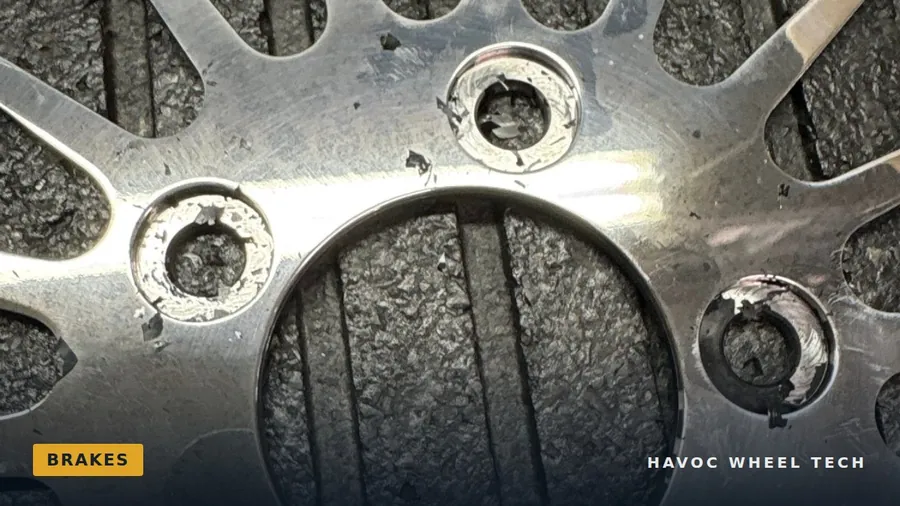
Polishing stainless steel is a demanding process, and it sometimes leaves small imperfections under the finish: tiny marks that are deeper than the surrounding surface and harder to polish out. They are cosmetic only. On the braking surface, they disappear the first time the pads sweep over them.
Mill scale under the rotor bolts
One detail matters far more than cosmetics. Stainless steel rotors are cut from hot-rolled plate, and the hot-rolling process leaves a hard, flaky oxide layer on the surface called mill scale. Where the rotor bolts clamp down, *that scale has to go*. It must be scraped off the mounting area under each bolt head, down to clean, bare metal, before the bolts are torqued.
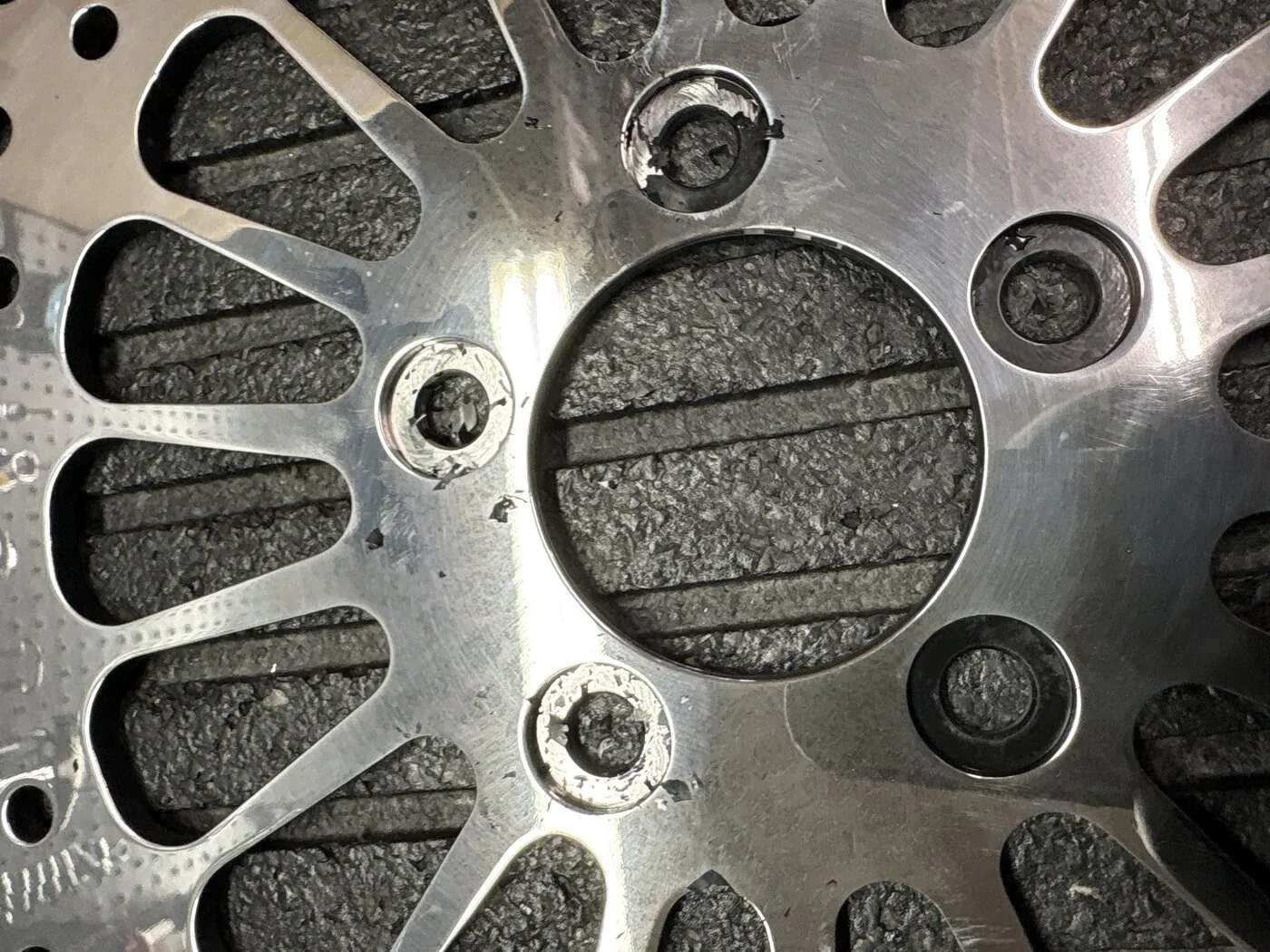
The reason is clamping force. A torqued bolt holds the rotor to the hub by stretching slightly and pulling the parts together, and that only works if the bolt head is pressing on something solid. Mill scale is not solid. It is brittle and loosely bonded, and it crushes and flakes under load. As the bolt is tightened, the scale breaks up under the head. The threadlocker on the bolt then mixes with the loose flakes into a paste, and the bolt head ends up seated in a layer of wet, crumbling debris instead of on metal.
The result is a bolt that is unlikely to reach proper torque at all. It keeps turning as the scale crushes beneath it, or it gives a torque reading without the clamping force behind it. Worse, whatever clamp it does achieve will not last: as the debris under the head continues to break down and settle in service, the bolt loses tension. A rotor bolt that has lost its clamp load can work loose, and a loose rotor bolt is a braking problem. Clean metal-to-metal contact under every bolt head is the only way to get a joint that torques correctly and stays tight. The same principle applies to the wheel itself: see Runout Tolerances: Why Thousandths Matter.
For that reason, we scrape the mill scale from the bolt seats of every rotor we supply, including rotors sold on their own, not just those fitted to our wheels. We do not want anyone installing one of our rotors without that step having been done. If you are fitting rotors from any other source, check the bolt seats before you torque, and if there is scale under the bolt heads, scrape it off.