
If you run an external amplifier on your Harley, you have probably heard it. You turn the key off, and a "POP" comes through the speakers. Some systems also pop when you turn the volume all the way down to 0, or when you switch modes, like from Bluetooth to radio.
It is one of the most common complaints in motorcycle audio. It is also one of the least understood. Forums are full of guesses: bad grounds, cheap amps, faulty head units. Most of those guesses are wrong.
We chased this pop down on the bench while setting up our HRS kits. This article explains exactly what causes it, what we tried that didn't work, and the simple fix we now build into every kit.
How an amplifier knows when to turn on
An external amplifier switches on and off on command from the head unit, through a thin wire called the remote, trigger or turn-on wire.
The amplifier is wired straight to the battery, so it always has power available. It would drain the battery if it stayed on, so it waits for a signal. That signal is the remote wire, usually blue.
- Remote wire at about 12 V: the amplifier turns on and plays.
- Remote wire at 0 V: the amplifier shuts down and draws almost nothing.
The head unit controls this wire. When you switch the radio on, it puts 12 V on the remote wire and the amp wakes up. When you switch the radio off, it removes the 12 V and the amp is supposed to shut down.
The key words are "supposed to". Removing the 12 V is not the same as pulling the wire to 0 V, and that difference is where the pop comes from.
Why the pop happens
The pop happens because the remote wire falls to 0 V slowly, so the amplifier keeps playing for a split second after the head unit's audio has started to collapse.
When the head unit switches off its remote output, it doesn't actively pull the wire down to 0 V. It simply lets go. The wire is left floating, with nothing connecting it firmly to ground. The voltage on it bleeds away slowly, through whatever small leakage paths happen to exist.
The amplifier's turn-on circuit has a threshold. It stays on until the remote voltage drops below that point. A floating wire can hover above the threshold for tens or hundreds of milliseconds.
Meanwhile, the head unit is shutting down. Its audio outputs don't fade gracefully. As its internal power rails collapse, the output jumps or thumps. Normally that thump would go nowhere, because the amp would already be off.
But the amp is still on, because its remote wire hasn't fallen yet. So it amplifies the thump, at full gain, straight into your speakers. That is the pop.
In short, the order of events is wrong. The amp should switch off first, then the head unit. A floating remote wire reverses that order.
This also explains why the pop is louder on more powerful systems. The thump from the head unit is the same size. A high-gain amp simply makes it louder.
Why it also pops at volume 0 and when changing source
Many head units also drop the remote wire to mute the amplifier, so the same slow-falling wire causes a pop at volume 0 and when switching source.
We found this by accident. After fixing the key-off pop, the pops at volume 0 and on source change got much softer or disappeared completely. That told us they shared the same cause.
Here is what's happening. To keep the amp quiet during a transition, many head units briefly switch off the remote output:
- When you turn the volume to 0, the head unit mutes its output and drops the remote signal.
- When you change source, say from Bluetooth to radio, it does the same while it switches over, then restores it.
Each time, the remote wire floats down slowly instead of dropping cleanly. The amp lingers on while the head unit's output changes state, and you hear the same thump.
The source-change pop often seems random. It happens some of the time, not every time. That's because the size of the thump depends on what the audio is doing at the exact moment the head unit switches over.
What doesn't fix it
The usual suggestions don't work, because most of them treat the pop as noise when it is really a timing problem.
- A capacitor on the remote wire. This is a common forum fix, and it makes the pop worse. A capacitor stores charge, so it holds the remote wire up for longer. That keeps the amp on even later. Capacitors are a fix for a turn-on thump, not a turn-off pop.
- A diode in the remote wire on its own. It blocks current flowing back the wrong way, but it does nothing to pull the wire down. The wire still floats, and the pop stays.
- Ground-loop isolators and ferrite cores. These reduce hum and interference picked up by the wiring. The pop isn't interference. It's the amp being on when it should be off, so these do nothing for it.
- Turning the amp gain down. This makes the pop quieter, because it makes everything quieter. It also costs you volume, and it doesn't remove the cause.
- Rewiring the remote to the bike's ignition circuit. This can work, because the ignition feed drops the instant the key turns off. But it means cutting into the bike's wiring or fuse box, which most riders shouldn't have to do.
We wanted a fix a rider could install themselves in a few minutes, with no cutting and no fuse-box work.
The fix: a bleeder resistor
A 1 kΩ resistor from the remote wire to ground pulls the wire to 0 V the instant the head unit lets go, so the amplifier switches off before the head unit's output can thump.
The idea is simple. The problem is a wire left floating. The fix is to give it a path to ground, so the voltage has somewhere to go.
With the resistor in place:
- The head unit switches its remote output off.
- The resistor drains the remote wire to 0 V almost instantly.
- The amplifier sees its turn-on signal disappear and shuts down straight away.
- The head unit's output thumps as it shuts down, but the amp is already off, so nothing reaches the speakers.
The order of events is now right: amp off first, head unit second.
How we proved it
We tested the idea before building anything. With the system playing, we clipped an ordinary incandescent 12 V test light from the remote wire to ground. A test light bulb is a resistor of roughly 100 Ω. We switched off, and the pop was gone.
That confirmed the cause. Then we replaced the test light with a proper 1 kΩ resistor and repeated the test. The key-off pop was gone again. The pops at volume 0 and on source change went with it.
Why 1 kΩ
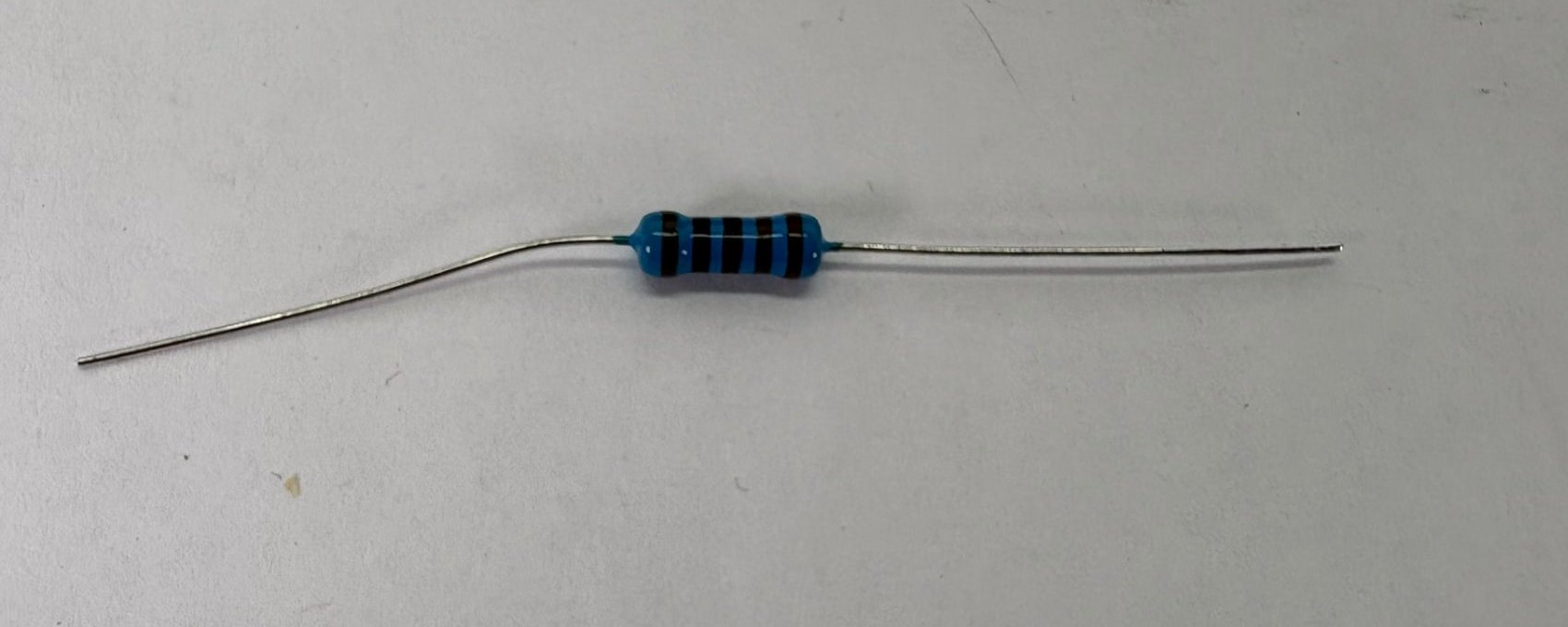
The resistor has to drain the wire quickly, without loading the head unit or getting hot. 1 kΩ does both.
While the system is on, the resistor sits across the 12 V remote signal and draws a small, steady current:
- 14 mA is a tiny load. A head unit's remote output can supply far more than that, so the amp still turns on normally.
- 0.19 W is well within the rating of a ½ W resistor, so it barely gets warm. It is safe to seal it inside heat shrink.
- A much higher value, say 10 kΩ, drains the wire too slowly to beat the head unit's thump.
- A much lower value draws more current from the head unit and runs hotter for no real benefit.
If a particular combination of head unit and amp still pops with 1 kΩ, a 470 Ω resistor drains the wire harder. It draws about 0.4 W, so it must be a 1 W resistor.
The Havoc Soft-Off lead
We packaged the fix as a plug-in lead, the Havoc Soft-Off, which installs in about five minutes with no cutting and no fuse-box work.
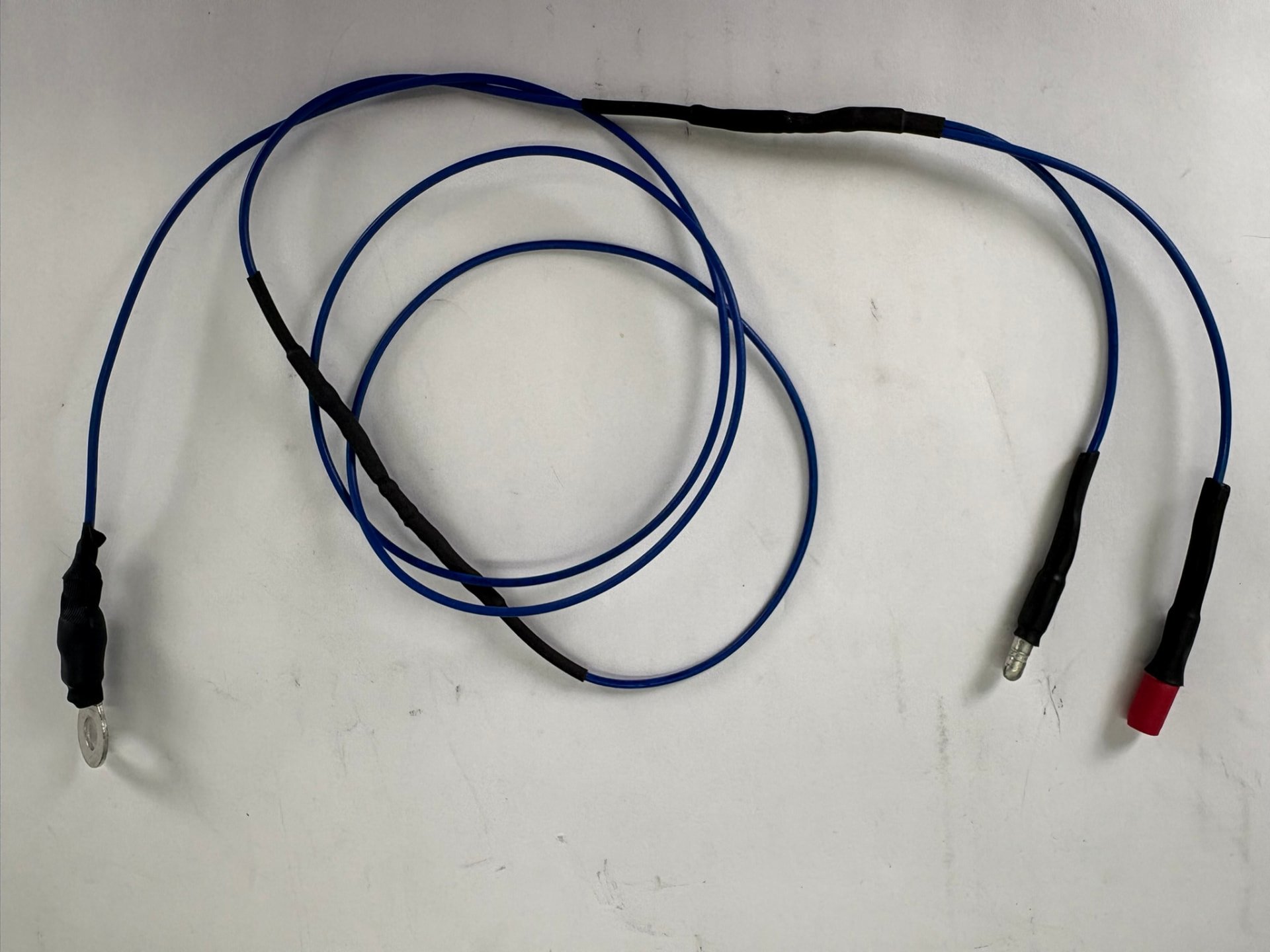
The lead is a short Y-adapter that sits in the amplifier's remote wire:
- A female bullet that plugs onto the amplifier's remote wire.
- A male bullet that plugs into the head unit harness, where the amp's remote wire used to go.
- A 1 kΩ ½ W metal-film resistor in the ground leg, sealed in adhesive-lined heat shrink.
- A ring terminal for the battery's negative terminal.
Installing it
- Unplug the blue remote wire where the amplifier's lead joins the head unit harness.
- Plug the lead's female bullet onto the male bullet on the amplifier.
- Plug the lead's male bullet into the female bullet on the harness. The lead now sits between the amplifier and the harness.
- Connect the ring terminal to the battery's negative terminal. If the stack of ring terminals is too thick for the stock bolt, use a longer one.
- Switch on, play some music, switch off and listen. The pop should be gone.
The Soft-Off lead now ships in every HRS kit with an external amplifier.
FAQ
Will the lead drain my battery?
No. The resistor only draws current while the head unit's remote output is on, about 14 mA. When the system is off, the remote wire is at 0 V and the lead draws nothing.
Is the pop damaging my speakers?
An occasional pop at a sensible gain setting is harmless. Repeated hard thumps on a system with the gain turned right up can stress tweeters over time. Either way, there's no reason to live with it.
Will it work with my amp?
It works on the same principle with any amplifier that uses a 12 V remote turn-on wire, which is almost all of them. We developed and tested it on our HRS systems.
Will it fix hum, buzz or whine?
No. Those are noise problems, usually from grounding or the bike's charging and lighting circuits. The Soft-Off lead fixes pops caused by the amp switching off late.
Can I make my own?
Yes. You need a 1 kΩ ½ W resistor, a length of wire, two bullet connectors to match your amp's remote wire, a ring terminal and some heat shrink. Splice the resistor into a ground leg off the remote wire and run it to battery negative.
The takeaway
The pop isn't a bad amp, a bad speaker or a bad ground. It is a timing problem: the amplifier switching off after the head unit instead of before it. Give the remote wire a path to ground, and the amp switches off first, every time.