
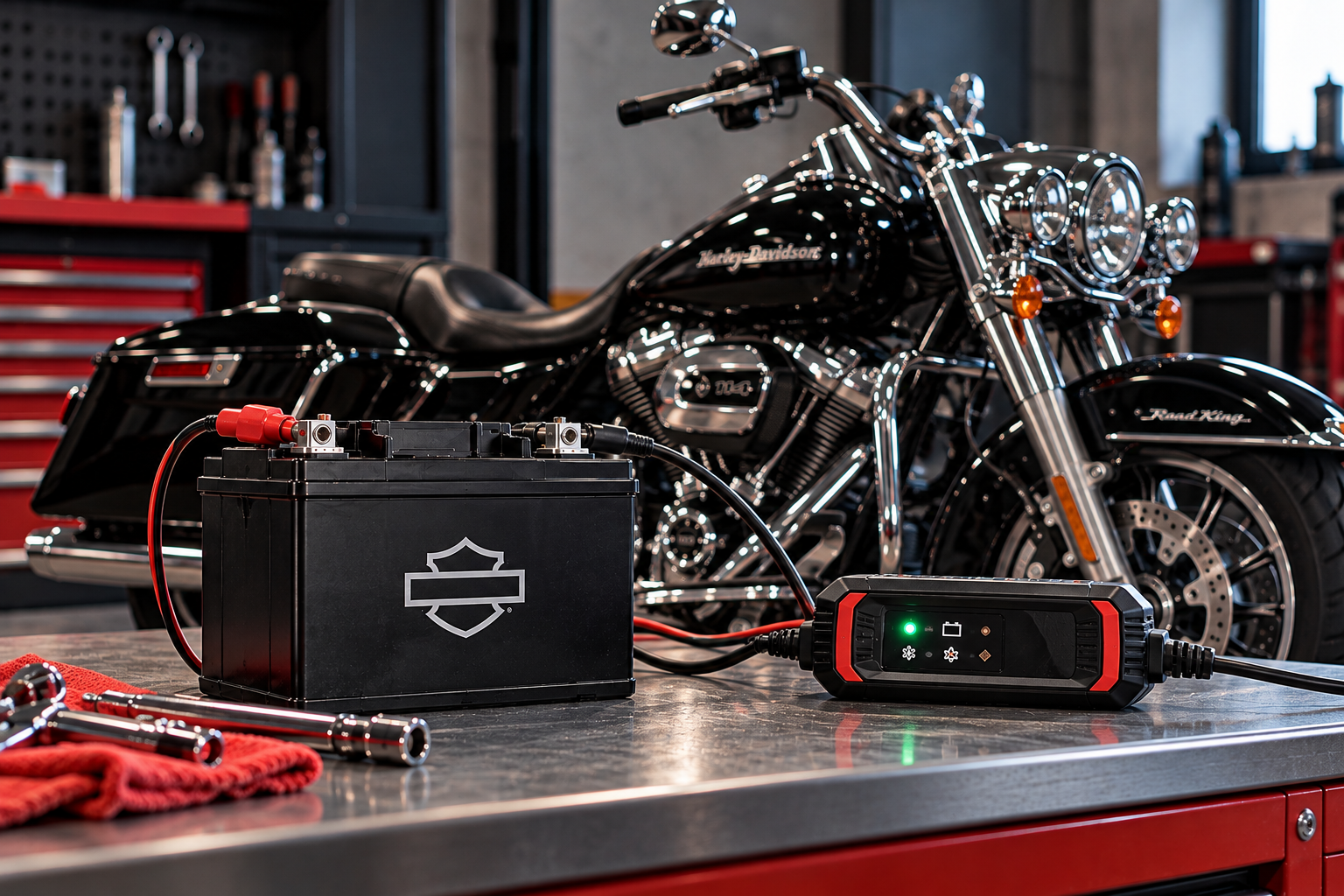
It happens a dozen times every Spring. You hit the starter, the bike fires up instantly, and the battery tender under your bench has been glowing a steady green all winter. But your Aquatic AV radio won’t power up. Or the radio gets power but there is no sound. Either way, you think it’s something wrong with the radio. 'It can't be the battery. The bike starts fine.'
We don’t like arguing with customers, but we usually do insist that, yes, it can be your battery. Sometimes people lose their tempers with us, because they think we’re trying to deny the warranty claim. Actually, what we’re trying to avoid is the cost of sending us the unit, the bench test fee, and the return shipping since 9 times out of 10, it’s the bike’s battery.
A motorcycle battery has more than one job. Just because it can spin your engine over once a day doesn't mean it has what it takes to feed a heavy-duty stereo like the Aquatic AV that has a 288w amplifier built into it. Here is what is actually going on under your seat—and why a 'good' starting battery might not be up to the task of starting your audio system.
1. Starter vs. Stereo: Two Completely Different Jobs
Your battery handles two totally different tasks, and they put very different demands on your electrical system:
Starting the Engine: The starter needs a burst of raw current for just a second or two (called cranking amps). During those few seconds, the battery's voltage can take a heavy dive—and that's okay. As soon as the engine fires, the starter shuts off, and its job is done.
Powering the Stereo: Your amplifier doesn't need a quick 2-second burst; it needs steady, smooth power continuously (called continuous current). Every time the bass hits, the amp snaps its fingers and demands a sudden chunk of current. If the battery can't supply that power smoothly, the voltage drops.
A battery that is 'good enough' to spin a starter motor can easily choke when an 800-watt or 1,200-watt stereo starts pulling heavy current out on the highway, and if it’s really poor, then yes even a 288w amp inside the radio.
2. Why Cold Cranking Amps (CCA) Don't Tell the Whole Story
Most riders look at one number on a battery label: CCA (Cold Cranking Amps). CCA simply measures how much raw current a battery can dump out in a short burst at freezing temperatures to get a cold engine turning.
What CCA tells you: 'Can this battery punch hard enough to start the bike?'
What CCA DOESN'T tell you: How long the battery can hold up under a heavy, continuous load; how much energy reserve capacity is actually left inside; or how healthy the internal plates are after years of heat and vibration.
An older battery can still hold enough surface charge to turn your starter motor, while its actual internal capacity is shot. The moment your amplifier asks for real power, the battery's voltage collapses, the amp thinks there is a short circuit, and it shuts itself off to prevent burning up.
3. The Battery is Your Audio System's 'Power Buffer'
Riders often assume that once the bike is running, the charging system (the stator) runs everything. Not quite.
At low speeds or at a red light, your bike's charging system produces very little extra power. Even at highway speeds, when a heavy bass note hits, your amplifier demands power faster than the bike's charging system can create it.
When that happens, your battery acts as a cushion (a buffer). It fills in the gap instantly to keep voltage stable. If that battery cushion is old, weak, or small, your entire electrical system takes a dive every time the music gets loud.
4. Why a Trickle Charger Isn't a Magic Fix
Battery tenders and trickle chargers are great tools for winter storage, but they trick a lot of riders.
What a tender DOES do: Keeps a healthy battery from slowly dying while the bike sits idle in the garage.
What a tender CANNOT do: It cannot bring back lost storage capacity in an old battery, fix worn-out or damaged internal plates, or turn a weak battery into a strong one.
You can have a battery that has been plugged into a tender all winter, shows a full 12.7V on a meter, and starts the bike without hesitation—yet still collapses the second your stereo starts pulling power. In the audio world, that battery is 'fully charged,' but it's physically weak.
5. Signs Your Battery Is Letting Your Stereo Down
Even if your bike starts up on the first thumb of the button, watch for these warning signs while riding:
1. The Amp Cuts Out: The stereo shuts off or goes into 'protection mode' only when you turn the volume up or when heavy bass hits.
2. Screen Flickering: Your head unit screen flashes or reboots when you crank the music.
3. Dimming Lights: Your headlight pulses or dims in time with the music beat.
4. Distorted Sound: The music sounds scratchy, thin, or muddy when you get above half volume.
6. What to Look For in an Audio-Ready Battery
If you are running an aftermarket amplifier and speaker setup on a Road King, Street Glide, or Softail, don't just buy the cheapest generic replacement battery:
Go with AGM (Absorbed Glass Mat) – the audio standard: AGM batteries handle vibration much better, hold up to heavy power draws, and don't spill. For high-output audio systems, a top-tier AGM battery (such as a Yuasa GYZ-series, Odyssey, or Stinger) acts like a heavy electrical flywheel. Its internal construction absorbs massive dynamic audio spikes gracefully without tripping protective circuits.
Look at Reserve Capacity & Amp-Hours (Ah): Don't just look at CCA. Look for a high Amp-Hour (Ah) rating. That tells you how much total energy storage is packed inside the case.
Match with Good Wiring: Even the best battery can't help your stereo if power is choked through tiny wires. Always run heavy 8-gauge or 4-gauge 100% Oxygen-Free Copper (OFC) power and ground wires straight back to the battery terminals.
The Starter-Lithium Trap: Why AntiGravity and Similar Batteries Can Struggle
A very common observation among riders upgrading to big audio systems is that high-end starter lithium batteries (like AntiGravity, Shorai, or EarthX) often underperform compared to a heavy-duty AGM battery when feeding a 800W–1,200W+ stereo. There is a real technical reason for this: they are tuned for Cranking, Not Continuous Audio Reserve
Lithium powersports batteries use Lithium Iron Phosphate () cells engineered for extreme short bursts of starting current (500+ Cranking Amps for 2–3 seconds). However, powersports-sized lithium cases simply do not have the physical cell volume required for high Amp-Hour () reserve capacity.
BMS Protection Trips: Most of those batteries feature an integrated Battery Management System (BMS) circuit that protects the battery from over-discharge and thermal overload. When a high-output Class-D amplifier demands rapid, violent current spikes on every heavy bass hit, the BMS can mistake that draw for an unsafe short circuit, momentarily throttling voltage and dropping your amplifier into low-voltage fault/protection mode.
Higher Internal Resistance When Cold: Lithium batteries exhibit higher internal resistance at lower ambient temperatures. Until the battery warms up internally, high-wattage audio demands cause severe voltage sag.
Conclusion: Building on a Solid Electrical Foundation
When you build a high-performance motorcycle audio system, the amplifier and speakers get all the glory, but the battery does all the heavy lifting.
If there is one key takeaway, it is this: your battery isn't just a starting device—it is an active component of your sound system. Cold Cranking Amps will get your engine fired up, but continuous energy reserve, low internal resistance, and steady voltage are what keep your music loud, crisp, and clear at 70 MPH.
A trickle charger can keep a tired battery topped up in the garage, and a lightweight starter-lithium battery can spin a high-compression motor, but neither can replace the raw reserve capacity needed to feed a hungry 1,000-watt amplifier on the open road.
Before you spend another dollar chasing audio distortion, amplifier cutouts, or flickering screens, look under your seat. Investing in a high-capacity AGM battery, running proper Oxygen-Free Copper wiring, and establishing solid grounds isn't just good maintenance—it is the essential foundation your stereo needs to play hard season after season.