
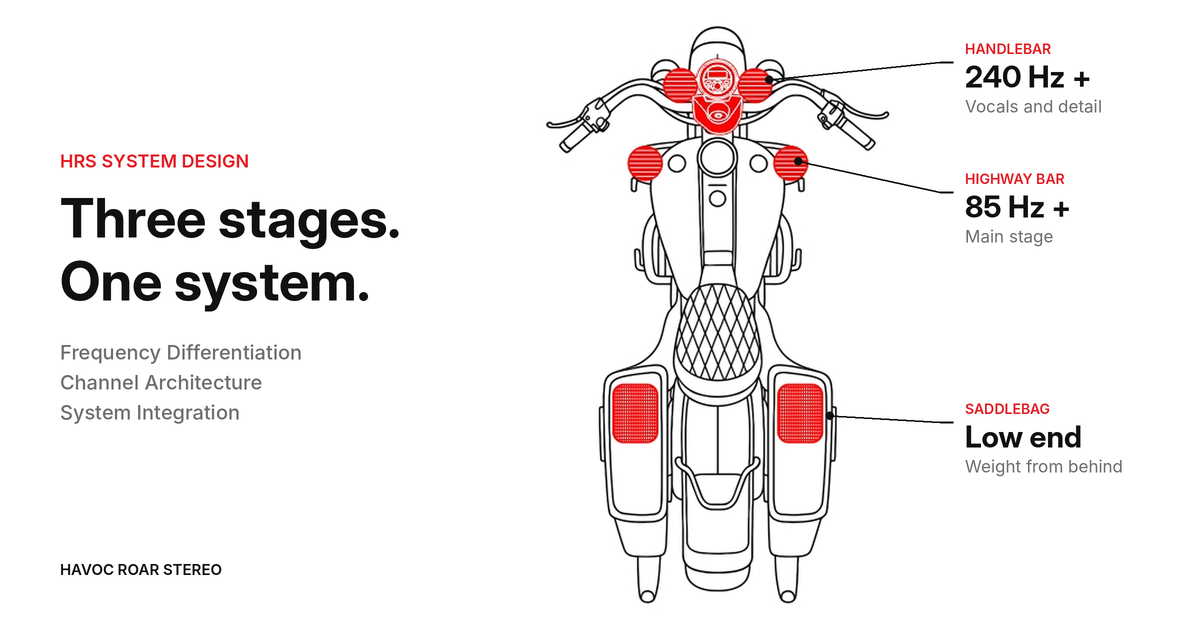
Havoc Roar Stereo is engineered on three principles:
Frequency differentiation: each speaker group is given the part of the spectrum it reproduces best.
Channel architecture: each group is powered from the source best matched to it.
System integration: speakers, housings, amplification, wiring and power are engineered as one installation, around one motorcycle.
1. The Problem: Open Air, Wind and Distance
Three physical facts shape every decision in an HRS system.
There is no cabin gain. In a car, the enclosed cabin reinforces low frequencies. On an unfaired motorcycle there is no such reinforcement. Bass must come from real cone area and sound placement.
Distance costs output. In open air, sound pressure falls by 6 dB every time the distance to the listener doubles. A speaker close to the rider has a built-in advantage over one further away.
Wind masks detail first. As speed rises, wind noise buries vocals and fine detail before it buries the beat. A system that is merely louder, with the extra output in the wrong frequencies, is not clearer.
The engineering answer is to divide the work.
2. Frequency Differentiation
Every speaker in an HRS system can reproduce music on its own. None of them is asked to reproduce all of it.
| Stage | Driver | Sensitivity (1 W / 1 m) | Power per speaker (RMS / max) | Role |
|---|---|---|---|---|
| Handlebar | 3.5” midrange, 2 Ω, high-passed at ~240 Hz | 84 dB | 50 W / 75 W | Vocals and detail, closest to the rider |
| Highway bar | Aquatic AV HS116 Neo 6.5” coaxial, 4 Ω | 96.5 dB | 120 W / 240 W | Main stage: midbass through treble |
| Saddlebag | Aquatic AV HS118 Neo 6×9” coaxial, 4 Ω | 90 dB | 120 W / 240 W | Low-frequency weight and rear fill |
2.1 Handlebar Stage: Detail Where the Rider Hears It
The handlebar 3.5-inch drivers are the closest speakers to the rider's ears, so they carry the information wind destroys first: vocals, guitars and cymbals. Their published response rises through the 2–8 kHz presence region, exactly where intelligibility lives.
A 3.5-inch cone has a resonant frequency of 80 Hz. Below that, excursion and distortion climb quickly. The driver's manufacturer rates its 50 W RMS power handling with a 150 Hz low-cut filter in circuit. In other words, the power rating assumes the filter.
HRS builds that filter in, and sets it higher than the manufacturer requires. A Nichicon ES-series 330 μF bi-polar capacitor in series with each 2 Ω handlebar speaker forms a first-order (6 dB per octave) high-pass at approximately 240 Hz.
A bi-polar capacitor is built for an alternating audio signal, unlike the ordinary polarised capacitor of the same value. Below 240 Hz, the work passes to the 6.5-inch highway-bar drivers, which are rated down to 100 Hz.
The 3.5-inch cone never receives bass it cannot reproduce cleanly. It runs well clear of its resonance and its rated limits. It spends its power on vocals and detail, and its closeness to the rider does the rest.
2.2 Highway-Bar Stage: The Main Stage
The highway-bar pods carry the system's main output. The Aquatic AV HS116 Neo is a 6.5-inch coaxial with a 35 mm tweeter, a 38 mm woofer voice coil and neodymium motors, rated 100 Hz–20 kHz.
Its 96.5 dB sensitivity is 12.5 dB above the handlebar drivers. That means it produces the same sound pressure with roughly one-eighteenth of the power. On a motorcycle, where every watt comes from the charging system, sensitivity is the specification that matters most. It is also why the HS116 was chosen.
For riders who want illumination, the Aquatic AV HS113 Ultra+ fits the same pods: RGB cone lighting, silk-dome tweeter, IP44 water resistance, 75 W RMS and 60 Hz–20 kHz response. The choice is light or maximum output.
The drivers sit in CNC-machined aluminium pods with a defined internal volume of 2.0 litres. Aluminum does not flex or resonate as plastic and stamped steel do, so the cone's energy goes into the air and not into the housing.
2.3 Saddlebag Stage: Weight From Behind
The Aquatic AV HS118 Neo 6×9 has the largest cone area in the system: about 1.6 times that of the 6.5-inch and roughly six times that of the 3.5-inch. On a bike without cabin gain, cone area is how bass gets made.
Its placement behind the rider is deliberate. The ear cannot reliably locate low frequencies, so bass from the saddlebags adds weight without pulling the stereo image backwards. Vocals stay in front, at the handlebars. Low-end weight fills in from behind.
The HS118 is a 2-way coaxial with a 25.4 mm tweeter, N38H neodymium motor and IP44 rating. Its 86.5 mm mounting depth fits stock Road King saddlebag lids.
2.4 What This Is, and Is Not
This is not a textbook three-way crossover, and it does not need to be. Two deliberate filters do the critical work. A passive high-pass at about 240 Hz keeps bass out of the handlebar drivers. On the external amplifier, an active high-pass at about 85 Hz keeps deep bass out of the highway-bar drivers, just below their rated 100 Hz limit. The handlebar stage plays from about 240 Hz upward. The highway-bar stage plays from about 85 Hz upward. The overlap between them is deliberate, so the hand-off is seamless. Driver size, sensitivity and placement assign the rest.
3. Channel Architecture
Frequency differentiation decides what each speaker does. Channel architecture decides how it is powered.
3.1 The GP1: Source Unit and Front-Stage Amplifier
Every HRS system is built around the Aquatic AV GP1 gauge-style stereo: Bluetooth, radio and physical controls within the rider's reach, set in a billet mount. The rider does not depend on a phone screen or a hidden module.
The GP1 is rated IP65 and has an aluminium chassis. Its Class A/B internal amplifier, stable down to 2 Ω, drives the handlebar stage.
The handlebar speakers are 2 Ω drivers for a reason: lowering the load impedance is how you get more power from it. Into 4 Ω, the GP1 delivers 45 W per channel; into the 2 Ω handlebar drivers, it delivers 72 W per channel. That is 60% more output from the same head unit, with no extra amplifier on the handlebars.
The GP1's 2 V RCA line output then feeds the external amplifier.
3.2 External Amplification for the Big Drivers
The highway-bar and saddlebag speakers run from a dedicated Aquatic AV Class D Shockwave amplifier. In the HRS-RK-624.4, that amplifier is the AD500.4:
100 W × 4 at 4 Ω, or 300 W × 2 bridged. HRS runs it bridged: one 300 W channel for each HS116.
0.05% total harmonic distortion at 50 W
Active high- and low-pass crossovers, variable from 40 to 400 Hz
Conformal-coated circuit boards, sealed to IP67
The AD500.4 runs with its high-pass filter engaged at about 85 Hz, so the 6.5-inch drivers receive only the frequencies they are built to reproduce. Gain is set by measurement, not by ear: 31.6 V at 1 kHz at the speaker, with the GP1 at volume 36. That matches each HS116 to the top of its rated range. It is a high-efficiency digital design. That matters on a motorcycle, where every watt comes from the charging system and heat has nowhere to go.
The small drivers get the head unit, and the large drivers get the amplifier. No channel is asked to do a job it was not sized for.
3.3 Configurations
| System | Speakers | Amplification | Rated power (peak / RMS) |
|---|---|---|---|
| HRS-RK-624.4 | 2× 3.5” handlebar + 2× HS116 highway bar | GP1 (2 × 72 W at 2 Ω) + AD500.4 bridged (2 × 300 W), high-pass at ~85 Hz | 624 W peak; speakers rated 340 W RMS |
| HRS-RK-1100.6 | Adds 2× HS118 saddlebag | GP1 + AD1200.4 | 1104 W peak; speakers rated 704 W RMS |
We publish both peak and RMS figures, because adding up peak ratings tells you little. Sensitivity tells you more: every 3 dB of sensitivity is worth doubling amplifier power.
4. System Integration
A speaker is only as good as its installation. HRS is engineered as one system for one motorcycle:
Housings: CNC-machined pods, built around the specific driver they carry.
Mounting: rigid fixings to the handlebar and engine guard to minimise vibration and resonance.
Wiring: UL-certified wire, cut to length harnesses, plug-and-play Deutsch connectors, with abrasion shielding.
Power: a dedicated, fused amplifier supply, with a sealed head unit (IP65) and amplifier (IP67) built for open-air riding.
Appearance: every component is designed to look like it belongs on a Road King or Softail, because function first does not mean function only.