
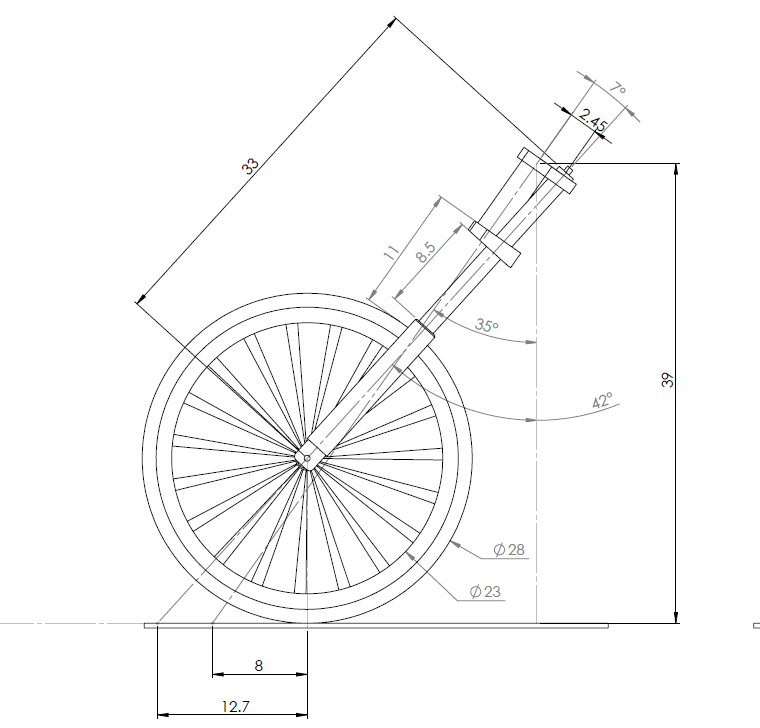
We get the same questions every week: if I run a 21" on the front, do I need an 18" on the rear to "match" it? Should I lower the front of the bike? And, will the front fender clear? Does a 21" front change the geometry of the front suspension? So, we thought it would be helpful to explain the issues here, but remember: we're always happy to keep having those conversations, so if you'd like to talk, give us a call.
IF I USE A 21" FRONT, DO I HAVE TO RUN AN 18" REAR?
The reason this might get confusing is that wheel size does not automatically tell you actual ride height, because as you go up in wheel size, the sidewall of the tire goes down. And, it's overall tire diameter that determines axle height, available clearance, and how the bike sits under load.
So, before we go any further, we should put numbers on the most common tire sizes we see in these conversations. The following diameters are the overall tire diameters, because those are what control ride height and geometry, not the rim diameter printed on the wheel.
| Tire size | Typical position | Overall diameter (in) |
|---|---|---|
| 130/90-16 | Front or rear | 25.21" |
| 130/70-18 | Front | 25.17" |
| 130/60-21 | Front | 27.14" |
| 180/55-18 | Rear | 25.80" |
| 150/80-16 | Rear | 25.45" |
| 180/65-16 | Rear | 25.21" |
| 150/70-18 | Rear | 26.27" |
| 130/60-19 | Front | 25.14" |
Those numbers show an important point: a wheel size change does not automatically mean a big stance change. The 130/90-16 at 25.21" and the 130/70-18 at 25.17" are essentially the same overall diameter. That means a 16 versus 18 conversation is often more about appearance—how much wheel you see versus sidewall—than it is about changing chassis geometry.
AXLE HEIGHT IS HALF THE DIAMETER CHANGE
When you go up in size, only half of the height difference lifts the bike, because the other half is above the axle (it can affect fender clearance – more on that later). For now, if you want to compare the ride stance of any two setups, use one simple relationship: axle height changes by half of the diameter change. If the new tire is 1.0" larger in overall diameter than the old tire, the axle rises by roughly 0.5". This is the most reliable way to take sizing out of opinions and put it into geometry.
Here is what that looks like with the sizes above. On a Road King-style baseline, a stock 16" front with a 130/90-16 is 25.21". The 130/60-21 at 27.14" is about 1.93" larger in diameter than a 25.21" front tire, but because only half of that is below the axle, the front axle rises by roughly 0.965". Put plainly: that common 21-inch front tire raises the front of the bike by about an inch. Once you see that number, you can judge whether you want the stance change, rather than reacting to the "five-inch difference" you see when you compare 16" and 21" on paper.
Other Touring models often use a 17-inch front and later 18/19-inch fronts depending on year. But the same logic applies to the switch from the 130/60-19 at 25.14" to the 130/60-21 at 27.14". You are not "adding two inches of ride height" just because the rim diameter number changed by two inches. You are increasing overall tire diameter by about 2.00", which raises the front axle by about 1.00" (half the diameter change), and the rest of that increase sits above the axle. In other words, regardless of whether you start at 16, 17, 18, or 19, you can predict the stance change accurately by comparing overall tire diameters and halving the difference.
On the rear, the same logic applies. Let's look at baggers first. A 180/65-16 on most stock 2009-later Harley Touring bikes (not Specials or CVOs) is 25.21". Going up to an 18" rear often means a lower-profile 180/55-18, which at 25.80" is only 0.59" larger in diameter, and that is roughly 0.30" of axle rise. On the Softails, a 150/80-16 on the rear of a Heritage is 25.45" tall. Going up to an 18" with a 150/70-18 gives an overall diameter of 26.27", which is 0.82" larger in diameter, or about 0.41" of rear axle rise. Those are of course changes, but that last example—less than ½" of rise—is far less than the 2" difference in wheel size, so it is not the dramatic transformation you might assume when you only compare wheel diameters.
WHAT ACTUALLY CHANGES WHEN YOU GO 21 FRONT
Most riders choose a 21-inch front because it visually lengthens the motorcycle and cleans up the front end. The engineering reality is that a 21-inch front changes three things: stance, fender clearance, and steering feel (rake and trail).
Stance is the easy one: from the discussion above, you now know the approximate axle height change of about 1" when you go from a typical 16" front tire to a common 21" front tire. Should you lower the front of the bike, or go with an 18" rear? Usually, lowering the front is not necessary, and if you do, keep it conservative. If your 21-inch front tire raises the axle by about an inch, that does not automatically mean you must lower the bike. Many Touring bikes tolerate that change well, and many riders prefer the stance. If you want to bring the nose back down for appearance, you can, but we generally advise that any lowering be modest—no more than about an inch—because aggressive drops reduce usable suspension travel and increase the chance of contact events under braking or large bumps. It is easy to make a motorcycle look low in a parking lot. It is harder to keep it behaving properly when the road stops being smooth.
If it was our bike, assuming it's a Touring model, we'd go up from the 180/65-16 rear to the 180/55-18, which raises the rear axle by about 0.30". That leaves a height difference at the front of about 0.67" (roughly 0.965" front rise minus 0.30" rear rise), which is pretty minimal. This is in preference to lowering the bike by 1". Yes, that keeps the stance the way it was, but it also sacrifices 1" of travel. You can improve bottoming resistance with progressive springs, but physics is physics—you still lose 1" of available travel.
Clearance is a practical concern, because fender clearance is what determines whether the setup is trouble-free. But fender clearance is actually a full-compression problem. Most stock fenders designed around OEM diameters will not clear a 130/60-21 without either a 21-specific fender or a lift/relocation approach, and clearance must be verified at full compression. Some riders will alter the front fender by "ovalling" the rear fender-mount holes and rocking the fender back. That is doable, and it keeps the fender from riding too high, but at the expense of drilling into your fender. The fender lift bracket does what it says: it lifts the fender away from the tire. Normally, this isn't an issue, but on bikes with a more compliant front suspension that can compress more easily (often Softails and some Road King setups) we have seen cases where a raised fender can be driven back far enough on a sharp bump at full suspension compression to contact an engine guard. It is not guaranteed to happen, but it is real enough that it belongs in an honest fitment guide. This is where progressive fork springs (of stock height) really come into their own.
Steering feel is the subtle issue. Raising the front slightly tends to slow steering response a touch, and we'll get into the rake/trail numbers below. But, and this is a huge "but", the tire's profile and construction can make as much or more difference to steering feel than the change in the rake/trail caused by the change in wheel diameter itself. The physics of the trail calculation doesn't change, but this is why some 21-inch setups feel perfectly normal and others feel reluctant to turn: the difference is often tire choice, not just the fact that the wheel is a 21".
RAKE AND TRAIL: WHAT CHANGES, AND WHAT YOU FEEL AT THE BARS
Front axle height change
130/90-16 OD = 25.21" → radius 12.605"
130/60-21 OD = 27.14" → radius 13.57"
Axle rise = (27.14 − 25.21) / 2 = 0.965"
Rake change (treating rear height as unchanged)
Chassis pitch change ≈ arctan(0.965 / wheelbase)
With 63.54" wheelbase ('09 Touring spec): Δrake ≈ +0.87° → new rake ≈ 26.87°
With 64.0" wheelbase (common later Touring spec): Δrake ≈ +0.86° → new rake ≈ 26.86°
Trail change (holding offset constant)
Δtrail ≈ +0.73"
So a typical Touring trail of ~6.69–6.70" becomes about ~7.42–7.43".
Bottom line: going from your 25.21" 16-inch front tire to the 27.14" 21-inch front tire raises the front axle by about an inch, which on the Touring chassis works out to roughly +0.9° of rake and about +0.7–0.8" of trail. In plain terms, that change will usually make the steering feel a little more stable and deliberate. The bike tends to track straighter at speed and feel calmer over imperfect pavement, but it also tends to take a bit more input to initiate a turn, and it won't "fall" into a corner quite as quickly as the smaller front diameter setup. That is not inherently good or bad—it is simply the predictable effect of adding trail: more self-centering and high-speed composure, with a small trade toward slower turn-in response.
It's also worth saying that wheel diameter is only part of what you feel at the bars. Tire profile can produce the same steering effects as rake and trail changes, and sometimes make them even more obvious. A tire with a more rounded, "pointier" crown tends to transition onto its shoulder more easily, so the bike will initiate a lean with less effort and feel quicker to turn in. A flatter-profile tire spreads the contact patch differently and resists that transition, so the bike can feel heavier and more reluctant to tip in, even if the geometry is unchanged. That is why two bikes can both be "21-inch front" and still steer very differently, and that's where a lot of the forum arguments come from. The physics is universal; the tire choice often isn't.
DO YOU "NEED" AN 18 REAR IF YOU GO 21 FRONT?
In most cases, no. The common belief that a 21 front "requires" an 18 rear is largely an aesthetic convention, not a geometry requirement. Riders like the look of a taller front paired with a rear that shows more of their King Spokes or billet wheel design and less tire sidewall, and an 18" rear can deliver that. That is a valid reason to choose it. The point is simply that it is rarely necessary for function.
When you compare overall diameters, you can see why. Many common 16 and 18 rear tire choices are closer than the wheel sizes suggest, which means the bike's stance does not change as radically as people assume. In other words, going 21 front does not force an 18 rear. Choose the rear wheel size based on the look and the tire profile you want, not because you think the front wheel size dictates it.
16 vs 18 rear: the honest trade-offs
The rear decision is mostly about two things: the look and the behavior of the tire sidewall. More sidewall generally gives you more compliance, more impact absorption, and a little more forgiveness on rough roads. Less sidewall generally gives you a firmer, tighter feel, but it can be harsher and it offers less cushion when you hit sharp edges. On a heavy bike, that matters, because wheel and tire choices get punished by potholes and imperfect pavement.
There is also a practical, unglamorous factor: tire availability and selection can change with size. Some riders fall in love with a wheel size and then discover their preferred tire model is limited in that size—and, in the case of whitewalls, only available from one brand. A fitment decision is not complete until the tire decision is also locked, because the tire is what sets the diameter, the profile, and the real-world clearance.
HOW WE CONFIRM FITMENT SO YOU DON'T GUESS
When we confirm fitment, we are not just checking a year and model. We are confirming the variables that actually control clearance and geometry: the front end type, the fender style, whether the bike has an engine guard, and the exact tire sizes you intend to run. That is also why two bikes that are "the same model" can behave differently once you factor in aftermarket parts, suspension condition, and how the bike is loaded and ridden.
If you want us to confirm your setup, send the bike year/model and your proposed front and rear tire sizes, and your preference for blackwall or whitewall tires. We will tell you what is possible in a straightforward way, what needs to change, and what combinations we would recommend.
FREQUENTLY ASKED QUESTIONS
Do I need an 18" rear if I run a 21" front?
No. The 21-front / 18-rear combination is mostly aesthetic, not a functional requirement. Choose your rear wheel size based on the look and tire profile you prefer, not because you think the front dictates it. Many common 16" and 18" rear tires have similar overall diameters, so the stance change is often minimal.
How much does a 21" front raise the bike?
A typical 21" front tire (130/60-21 at 27.14" overall diameter) is about 1.93" larger than a common 16" tire (130/90-16 at 25.21"). Because only half of that diameter change is below the axle, the front axle rises by roughly 1 inch. This is a predictable geometry change you can calculate for any tire swap using overall diameters.
Do I need to lower the front with a 21"?
Usually not. Many Touring bikes tolerate a ~1" front axle rise without issue. If you want to restore the original stance, we recommend raising the rear (example: going from 180/65-16 to 180/55-18) rather than aggressively lowering the front, which sacrifices suspension travel and can increase bottoming risk under braking or large bumps.
Will my stock front fender clear a 21" tire?
Most stock fenders designed for OEM diameters will not clear a 130/60-21 without modification. Options include a 21-specific fender, fender relocation/lift brackets, or modifying the fender mount. Clearance must be verified at full suspension compression, and bikes with compliant front suspension may need progressive fork springs to prevent contact on sharp bumps.
Why do two 21" setups steer differently? (tire profile)
Tire profile has as much effect on steering feel as rake and trail changes. A rounded, "pointier" tire crown makes the bike tip into turns more easily. A flatter-profile tire resists lean initiation and feels heavier to turn. This is why identical wheel sizes can produce very different handling, and why forum debates about "21-inch steering" are often really about tire choice.
What info do you need to confirm fitment?
Send us your bike year/model, your proposed front and rear tire sizes (including width/aspect/diameter), and whether you want blackwall or whitewall tires. We'll confirm clearance, stance, and any modifications needed, and recommend the best combinations for your setup.