
We get asked this all the time: "There are wheels on Amazon and eBay that look great in photos, cost a fraction of the price, and claim to fit my bike, so why do Havoc wheels and the other premium U.S.-made wheels cost more?" It's a fair question, because at a glance, a wheel is a wheel. The answer, however, is not in the styling or even in the finish. It's in the manufacturing route, the material system, the machining time, and the quality control that sits behind the part. Those are the things you cannot see in a listing photo, but they are exactly the things that determine whether a wheel is structurally predictable, dimensionally true, and consistent from one wheel to the next.
Low-priced marketplace wheels are almost always cast. Casting in itself is not a bad thing. Many Harley-Davidson models leave the factory on original equipment cast aluminum wheels, and those wheels exist inside a real engineering and validation system that has material specifications, controlled manufacturing, and product standards that an OEM has to meet at scale. When you buy OEM, you are buying into a manufacturer's validation and traceability system. When you buy an anonymous wheel, you are buying a photo and a price. So, the point of this article is not to "bash cast wheels," because reputable cast wheels can be perfectly sound. The warning is aimed at a different category entirely: ultra-low-priced marketplace wheels sold under unknown or disposable brand names, where the manufacturing process, alloy, heat treatment, and inspection practices are effectively unverifiable to the buyer. In that situation, you are not comparing "cast versus billet" so much as known manufacturing control versus unknown manufacturing control. If you cannot trace who made the wheel, what alloy was used, how it was processed, and how it was inspected, then the part is not cheap because someone found a clever shortcut. It is cheap because expensive steps were removed, and those are the steps that determine whether a wheel is structurally predictable and consistent from one unit to the next.
So, this article is not written to scare you away from casting or to claim that every cast wheel is bad. High-quality cast wheels exist, and reputable manufacturers can produce excellent castings. The warning is more specific: if the wheel is cheap enough to undercut the market, and the manufacturer, the materials, the process, and the quality system are effectively invisible, the risk is not just cosmetic, it is structural and dimensional, and it is paid for later in fitment headaches, inconsistency, and performance. With that context, we can now define what billet and cast actually mean, and the issues in manufacturing and materials that really matter.
What This Article Is (and Isn't)
Casting isn't automatically bad—many OEM wheels are cast and work fine in validated systems. The risk comes from unknown processes, unverifiable alloys, and lack of inspection standards. This article explains what to look for and why manufacturing details matter on heavy bikes.
DEFINITIONS: BILLET VS CAST
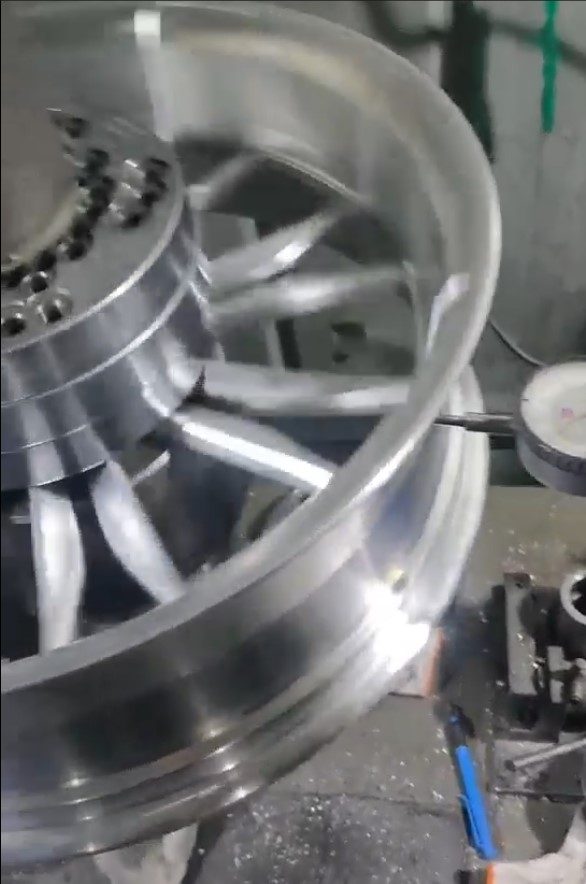
A billet wheel is manufactured from a solid piece of aluminum (a billet) that is then CNC-machined into its final shape. Because the wheel begins as a homogeneous, wrought product, the material properties are generally consistent throughout the part, and the geometry is created directly by machining rather than by the accuracy of a mold. In practical terms, billet construction gives the manufacturer maximum control over the critical interfaces like bearing bores, hub faces, rotor mounting surfaces, and concentricity, because those features are defined by the machining process and verified by measurement.
A cast wheel is manufactured by pouring molten aluminum into a mold and allowing it to solidify into a near-net shape, after which the wheel is machined where required. Casting is not inherently "bad," and high-quality casting can produce excellent wheels; however, casting quality varies dramatically depending on alloy selection, melt control, mold design, solidification behavior, heat treatment, and inspection practices. The catch is that the cheapest cast wheels often reduce cost by reducing process control and inspection, which is where you see variation from wheel to wheel and, more importantly, variation in the geometry of the interfaces that must be correct for the wheel to run true on a motorcycle.
The difference that matters to the rider is not the label—it is the combination of material consistency and tolerance control. On a motorcycle, small errors do not stay small. If a wheel's mounting faces are not perfectly flat and square, if the bearing seats are not truly concentric, or if the rotor mounting surface is not running true, those errors show up as brake pulse, vibration, and a bike that never feels settled. This is why "it looks fine" is not a meaningful standard for wheels, and why a wheel that is inexpensive enough to undercut everyone else should prompt one simple question: where was the time removed - machining time, inspection time, or both?
MATERIAL INTEGRITY & ALLOY CHOICE
A billet wheel and a cast wheel can both be made from "aluminum," but they are not the same object in engineering terms. A billet wheel is produced from wrought stock: material that has been mechanically worked (rolled or forged into billet form) before any wheel machining begins. That working process refines the grain structure and reduces internal discontinuities, which is why billet stock tends to have more uniform mechanical properties from one part to the next. When you machine a wheel from billet, you are largely inheriting the consistency of the starting material, then using machining to create the final geometry without relying on a mold to define the structure of the part.
A cast wheel begins life as liquid metal, and the internal structure is created during solidification. That matters because the solidification process determines grain size and direction, and it also determines the likelihood of porosity (tiny internal voids) or inclusions. Good foundries control this extremely well through melt practice, degassing, gating and risering design, and heat treatment. Poorer casting practice can leave more internal variation, and that variation is exactly what riders sometimes describe as a wheel that "rings like a bell" or, conversely, a wheel that feels dull or "dead" when tapped. That ringing sensation is not a laboratory test, but it is often a rider's crude way of noticing that different wheels can have different damping behavior depending on their microstructure and internal defects. A cleaner, more uniform material tends to transmit vibration differently than a material with more voids and discontinuities, which can dissipate energy and change the sound and feel.
NOTE: OEM Cast Wheels
OEM cast wheels exist in a validated system with controlled alloys, tested processes, and quality assurance. They're engineered for their specific application and backed by the manufacturer.
STRENGTH & DURABILITY
Billet aluminum wheels are normally made from Al 6061-T6. Where people get misled is assuming a "cast aluminum wheel" is simply a cast version of the same material. But most wheel castings are not 6061. Al 6061 has limited castability and is not well suited to shape casting because of its low silicon content, so cast wheels typically use higher-silicon casting alloys such as A356, which pour and fill molds well but generally land at lower yield strengths in common T6 conditions.
When we talk about the strength of wheels, the relevant concerns are yield strength (resistance to permanent deformation), fatigue strength (resistance to cracking under repeated load cycles), and impact resistance (how a wheel behaves when it sees a sharp event like a pothole hit). Billet material, by virtue of its wrought grain structure and consistency, generally performs very well in fatigue-sensitive applications, because crack initiation is less likely when the material is uniform and free of significant voiding. Cast material can also be strong and durable. Again, high-quality casting can be excellent. But its performance is more dependent on process control, because internal discontinuities become natural initiation sites for fatigue damage over long service life. This is why, all else equal, a billet wheel gives you more predictable structural behavior and more consistent life across production.
The durability of wheels has two meanings that customers often mix together: structural durability (how long the wheel survives mechanically) and surface durability (how the finish holds up). Structurally, billet wheels are often favored for heavy motorcycles because they can be designed with precise material placement: you put material where it carries load, and remove it where it does not. That design freedom, paired with consistent starting stock, is what allows a billet wheel to be both stiff and long-lived without becoming unnecessarily bulky. Cast wheels can be durable as well, but the design is constrained by casting requirements (draft angles, section thickness transitions, and feed paths during solidification) which can force compromises in how material is distributed. Those compromises do not automatically make a cast wheel "weak," but they can limit how precisely you can tune stiffness and long-term behavior in critical areas.
It is here that material choice matters a great deal. Billet aluminum wheels – ours, and most other billet wheel manufacturers – are Al 6061-T6, which is a heat-treatable aluminum–magnesium–silicon (Al-Mg-Si) alloy. The "T6" temper means it has been solution heat treated, quenched, and then artificially aged to develop strength through precipitation hardening. People call 6061-T6 "aerospace-grade" because it's a widely used structural alloy in aerospace contexts thanks to its strength-to-weight balance, corrosion resistance, and good manufacturability (including weldability and machining), so it shows up in aircraft structures where those traits matter. Billet wheels made from 6061-T6 work with material where typical yield strength is in the same neighborhood as a baseline structural steel (like ASTM A36).
When a casting is "grainy", meaning it has a coarser microstructure, more porosity, and less consistent solidification, these discontinuities reduce the consistency of mechanical performance from wheel to wheel. That variability can show up as differences in microstructure and porosity that are not visible to the eye and are not reliably diagnosed by "tap tests," even though riders often notice differences in how wheels transmit vibration and sound. We have seen inconsistencies in cast wheels that either ring like a bell or make a dead thud when you tap them. A wheel that "rings" when tapped is not necessarily stronger; it may simply be stiffer in the sections you're exciting, with less internal damping, and that can correlate with a cleaner, more uniform internal structure. Conversely, a wheel that sounds dull may have more damping from geometry, coatings, or internal discontinuities. The honest engineering takeaway is that the sound is a clue, not a specification: it tells you that wheels can vary in how they transmit vibration, but it does not replace proper material control and structural design.
WARNING: Anonymous Marketplace Wheels
Anonymous marketplace wheels mean unverifiable alloy composition, unknown manufacturing processes, and no inspection standards. The "too-cheap" price often hides quality variables that matter when you're riding a heavy bike.
WEIGHT CONSIDERATIONS
It is a mistake to assume "billet is heavier" or "cast is lighter." The manufacturing method does not automatically dictate mass; the design does. A cast wheel can be made light if it is engineered and cast well, and a billet wheel can be made heavy if it is overbuilt. Where billet tends to win on performance is that CNC machining gives you the ability to remove material very selectively while maintaining strength and stiffness because you're not bound to the constraints of mold fill and solidification. That is particularly valuable on a motorcycle because weight at the wheel is both rotating mass and unsprung mass, and both have a real effect on steering response, suspension control, and the bike's willingness to change direction. A well-designed billet wheel can often deliver a more responsive feel without giving up structural confidence because the stiffness-to-weight trade can be managed very precisely.
CONCLUSION
Billet versus cast is not a style preference, and it is not a branding label. It is a manufacturing route that drives material structure, property consistency, and ultimately how predictable a wheel is in service. A billet wheel begins life as wrought stock with a refined, uniform grain structure, and it is then machined into final form with tight control over geometry. That combination of consistent starting material and dimensional control tends to produce a wheel with repeatable stiffness, repeatable mechanical behavior, and a more reliable stiffness-to-weight outcome when the design is executed properly.
A cast wheel can absolutely be a good wheel when the foundry practice is strong and the process is controlled, but casting is inherently more sensitive to variability because the internal structure is created during solidification. That sensitivity is precisely why the brand matters. With a reputable manufacturer, you are not just buying "a wheel," you are buying a process: controlled melt practice, documented alloy chemistry, degassing and filtration, gating that avoids shrink and turbulence, heat treatment that is done to a known recipe, and skillful final inspection. Those steps are what separate a casting that is structurally predictable from a casting that merely looks acceptable once it's polished and photographed.
The problem with anonymous marketplace wheels, meaning the cheap wheels on eBay and Amazon that seduce you with a shiny finish and a great price, is not geography (the place where they were made). It is the unknowability of the alloy, the process control, the heat treatment, and the inspection that should exist behind a safety-critical component. When the seller is a storefront name that can disappear overnight, and the product has no traceable paperwork, you have no way to know what alloy was actually poured, whether it was properly heat treated, whether porosity was controlled, whether any destructive testing was ever done, whether there is any process control behind the machining, or whether any meaningful runout and interface verification was performed before it went in a box. In other words, you are being asked to trust your motorcycle wheels to invisible manufacturing and quality systems. And if that quality system does not exist, you do not find out on a spec sheet, you find out after install.