
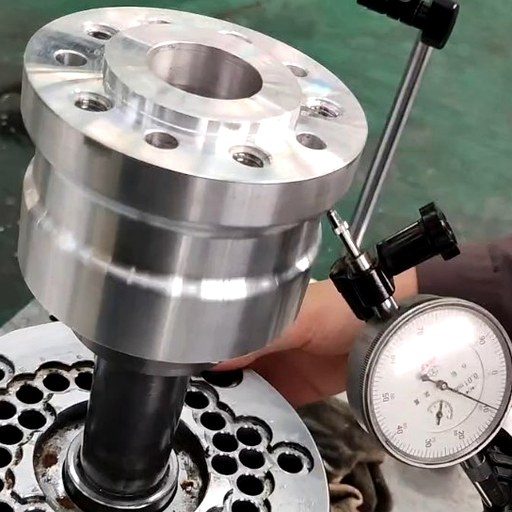
Most riders don't set out to become experts in vibration. But if you've ever swapped a wheel, mounted a fresh tire, balanced it, and still felt that annoying buzz at highway speed, you've been forced into it. You start blaming the tire (and very often, it is). So, you look to the balance. Then the bearings. And after enough time and money, you realize the real issue is precision: runout is the quiet culprit.
WHAT IS RUNOUT
Runout is simply how true a wheel runs as it rotates. Lateral runout is side-to-side movement, which presents as a "wobble." Radial runout is up-and-down movement, out-of-round, which presents as a "thump." Those sound like tiny things on paper, but on a heavy motorcycle at speed, tiny becomes real. A wheel doesn't need to be wildly off to make the bike feel unsettled. Just a few thousandths of an inch can be enough that you can't tune it out.
WHY BALANCING CAN'T FIX IT
Balancing can't fix runout. Balancing corrects weight distribution. Runout is geometry. If the wheel isn't running true, you're asking suspension and tire carcass to absorb a problem that shouldn't exist. That's how you end up with vibration you can feel, tires that start wearing weird and early, and a bike that never feels completely planted when you're cruising or leaning into a long sweeper.
WHAT "ACCEPTABLE" REALLY MEANS
Here's where it gets blunt. A lot of what the industry calls "acceptable" is not a performance target; it's a service limit. In other words, it's not "this is great," it's "this is still allowed." Cast wheels in particular can have a generous window of what's considered fine. That's mass production reality: yield, cost control, and the fact that replacement thresholds are designed to keep bikes on the road, not to make them feel glass-smooth. But riders feel the difference. "Good enough" costs you in comfort, tire life, and time spent chasing a problem that never should have shipped.
That's why we don't build to the edge of a replacement threshold. We build for the road. In terms of raw numbers, we target runout tolerances that are about four times tighter than common service-limit thresholds used for cast wheels. But - and this is an important part - runout isn't only a number; it's a system. Billet wheels need to be thought of as a system of interconnected parts, where a flaw in one aspect impacts across the entire system.
RUNOUT AS A SYSTEM
On bolt-on billet wheels, the hub mounts to a wheel interface, and the whole stack has to sit flat, center correctly, and clamp evenly. You can have a beautifully machined wheel and perfectly flat hubs, and still create runout if the interface stack is wrong. So each component has to be precise, and the entire mounting system has to be considered as an integrated whole.
FLATNESS COMES FIRST
Flatness comes first. The wheel mounting surface has to be flat. The hub face it mates to has to be flat. And the rotor mounting face needs to be flat too. If one of those faces is off, the wheel can be forced into a slight angle when the hub is torqued down. You might not notice it sitting still, but you'll feel it at speed. Worse, you'll chase it like it's a tire problem.
CONCENTRICITY
Next is concentricity. The locating flange on the hub that pilots through the wheel has to be concentric, and the matching bore in the wheel has to be concentric too. That pilot/register is what centers the wheel. If it's not right, the bolts end up doing the centering work, and bolts are terrible at centering. They'll pull the wheel into position in a way that looks "tight" but isn't truly centered, and the result is that you torque in wobble.
SURFACE QUALITY MATTERS MORE THAN YOU THINK
Then there's the stuff most people ignore until it bites them: burrs, high spots, and unfinished edges. Any surface that touches the wheel needs to be clean, smooth, and properly finished. Bolt holes matter. The inside edges of bolt holes need to be free of burrs and properly chamfered. If they aren't, the wheel may not seat evenly, and clamp load can become inconsistent across the face. That's how you get a wheel that's "tight" but not truly flat against the hub. It's also how you get mystery problems that come and go with torque sequence, heat cycles, or repeated installs.
If there's a burr on a mating face, a nick, an aluminum chip or a bit of debris, even a powder-coating ridge, or a sharp edge that holds the wheel off the hub by a hair - literally a human hair - that can become unacceptable runout. A human hair is only a couple thousandths of an inch thick, right in the same range as the tolerances that separate "runs true" from "chasing a vibration." If something that small gets trapped between the hub face and the wheel - a speck of grit, a powder-coat ridge, a tiny burr on a chamfer- it can hold the wheel off the hub just enough to torque in a wobble.
ANGULAR ERROR AMPLIFICATION
And once you move that error out to the rim, it becomes amplified. This is called angular error amplification: a tiny "shim" (hair, burr, paint ridge, grit) trapped at the interface creates a small angular misalignment (tilt) of the wheel's mounting plane. That tilt turns into much larger axial motion at the rim because of the lever arm (radius). In fact, a hair-thick high spot at the hub doesn't stay hair-thick, because it creates a tiny tilt angle, and that angle gets multiplied by the wheel radius. On a 21-inch wheel, 0.002" trapped at the mounting face easily can show up as anywhere from 0.007" to 0.028" of measured wobble at the rim.
Picture the wheel like a big, stiff dinner plate being clamped against the hub. If there's even a tiny speck trapped between them it doesn't just make a tiny "gap." It makes the whole wheel sit at a slight angle, like the plate is resting on a shim. That slight angle is the key. Once the wheel is tilted, the rim is way farther from the center than the hub is, so it swings through a much bigger motion. Near the hub, the movement is almost nothing. Out at the edge of a 21" wheel, that same tiny tilt turns into a visible side-to-side wobble because the rim is effectively the end of a long lever.
And here's the bottom line: we've seen enough horror stories to know ride quality shouldn't be decided by whoever's running the line that day. It should come from people who know exactly what they're doing, measure it properly, document it, and refuse to ship it if it isn't right.
THE HAVOC APPROACH
So what do we do differently? We measure and test with a repeatable process, correct what needs correcting, then verify the wheel is seated and registered properly before it leaves. The goal is simple: the wheel runs true, the bike rides smooth, and you don't spend your summer chasing vibration.
That's the Havoc approach. Precision on purpose.