
What Harley Fairing Speakers Can Teach Us About Sound
There's a reason motorcycle audio companies sell acoustic foam and sound-damping kits for Harley-Davidson fairings. A good speaker is only part of a good sound system. What surrounds it—and what happens to the sound coming off the back of the cone—matters enormously.
But what does that mean for riders who don't have a fairing? For Harley-Davidson Road King and Softail owners shopping for motorcycle stereo systems, the question becomes particularly important. Without a fairing to house the speakers, the design of the highway bar speaker pods is fundamental to audio performance – we spent months on it. The difference between a 5.25" speaker, a 6.5" in a plastic lower fairing pod, and a 6.5" speaker in a properly engineered enclosure goes well beyond the extra inch of speaker diameter.
In this article, we'll explore the engineering behind high-performance motorcycle audio, starting with speaker size and internal enclosure volume. We'll explain how the air trapped behind a speaker influences cone movement, resonance and bass response, and by the same token, why simply putting a bigger speaker in a bigger box doesn't necessarily produce better sound. We'll then examine speaker pod design and construction, and especially how enclosure geometry, wall rigidity and internal acoustic volume work together to control unwanted vibration and preserve sound quality. Most importantly, we'll explain how these engineering decisions affect what riders actually hear. Producing powerful motorcycle audio isn't simply about adding watts or chasing deeper bass. It's about delivering the punch, clarity and sound pressure needed to overcome wind and engine noise at highway speeds.
For years, companies such as J&M Audio—another of our favourites here at Havoc—have offered fairing acoustic treatments. More comprehensive products, including SoundSkins kits, tackle unwanted vibration and sound transmission. These products point to a useful lesson: improving the speaker's acoustic environment can improve what the rider hears.
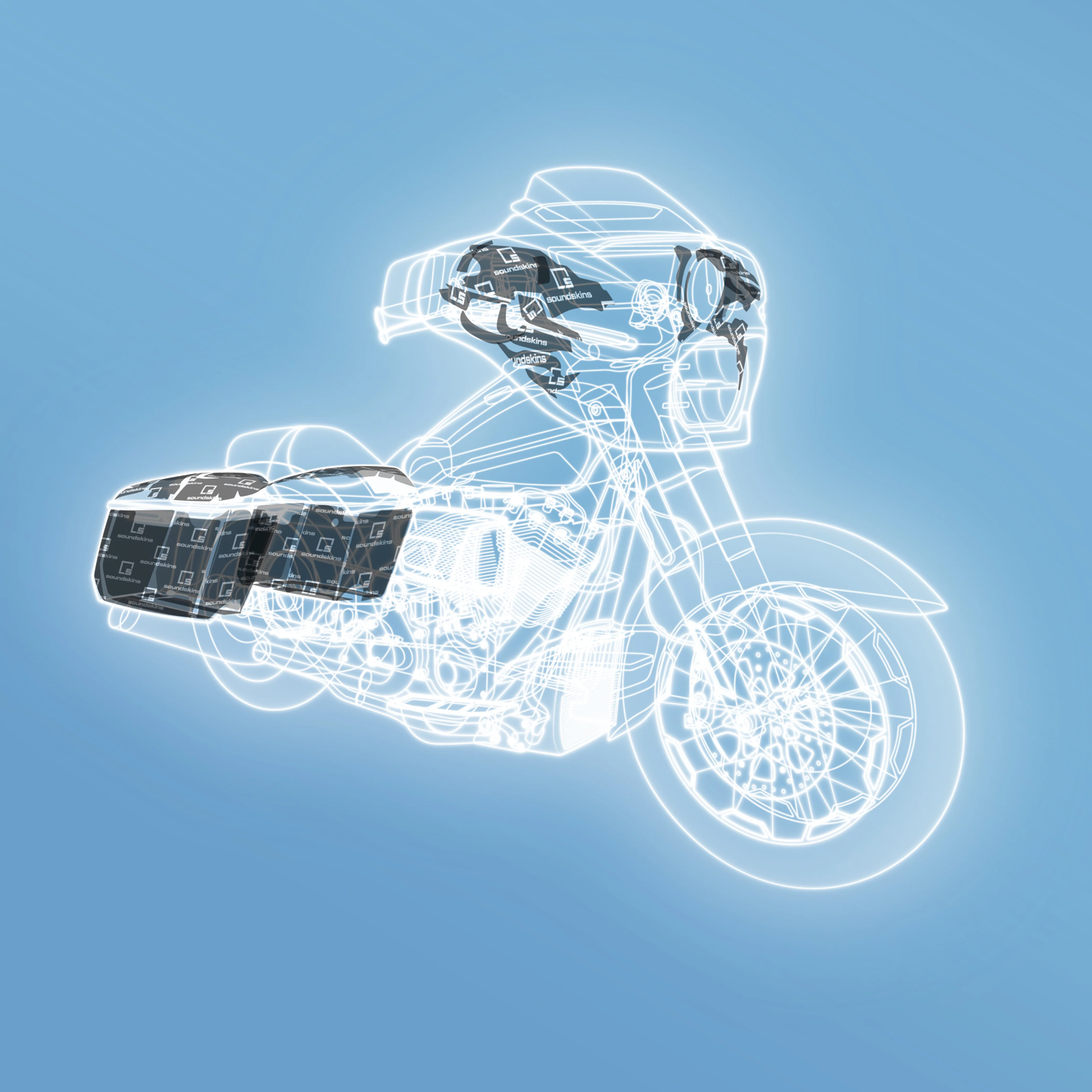
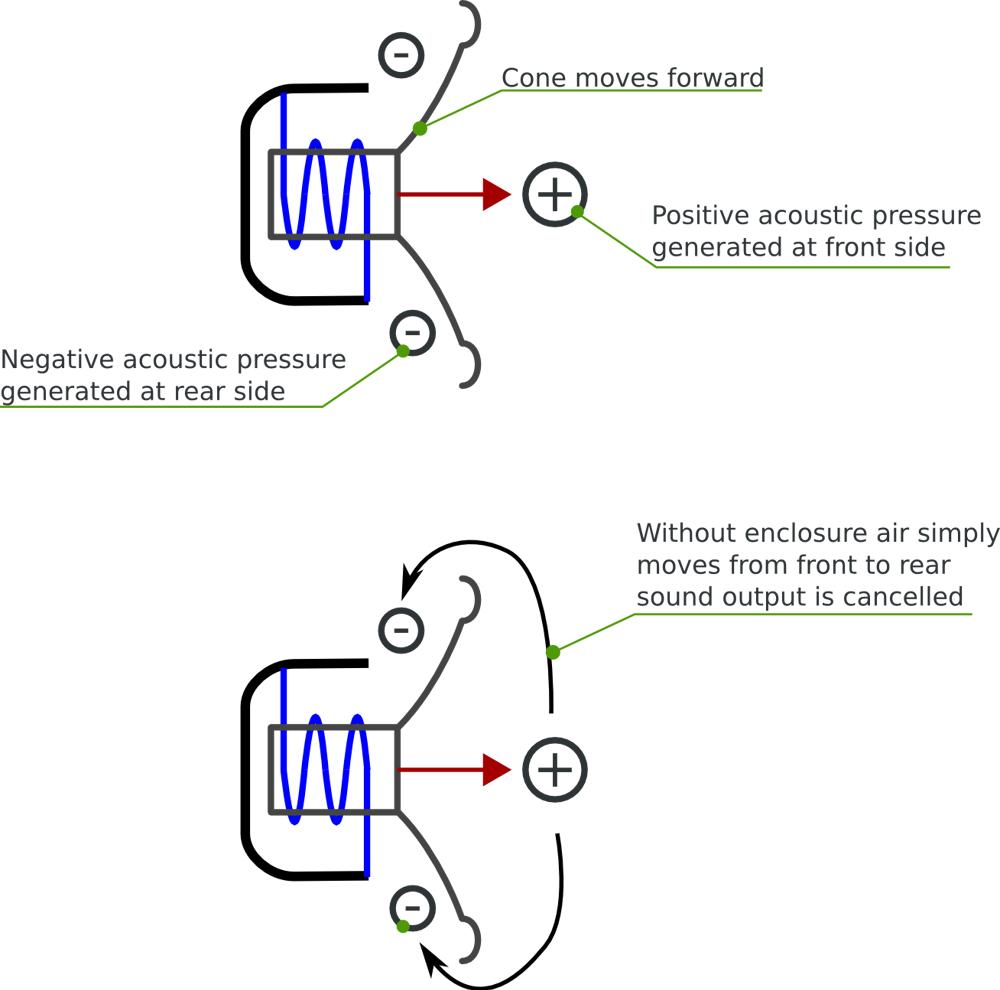
A fairing isn't necessarily a well-designed speaker enclosure. Its large plastic surfaces can vibrate, its internal cavities can produce unwanted resonances, and sound from the rear of the speaker can interfere with sound from the front. Acoustic treatments help address these problems, improving clarity and reducing unwanted vibration.
Properly applied acoustic treatments can improve clarity, reduce unwanted vibration and help preserve bass output. But not all acoustic treatments perform the same function. Sealing gaskets prevent sound from leaking around the speaker, viscoelastic damping sheets control panel vibration, and acoustic foam absorbs unwanted internal reflections. Each addresses a different problem. Let's look a little deeper into these.
1. Preventing Sound Cancellation
This is potentially the biggest benefit. When a speaker cone moves forward, it creates positive pressure in front and negative pressure behind it. Those sound waves are approximately 180 degrees out of phase. Foam gaskets and sealing rings around the speaker can reduce this leakage. However, ordinary foam pads stuck to the inside of a fairing won't necessarily prevent cancellation.
If sound from behind the speaker escapes around the mounting surface and meets sound from the front, the two can partially cancel each other, particularly at lower frequencies.
2. Reducing Unwanted Vibrations
A Harley fairing is a relatively large plastic structure. When a speaker produces bass, it can excite the fairing's panels, creating rattles and resonances. Sound-damping treatments reduce these unwanted vibrations, so you hear more of the speaker and less of the enclosure.
There's an important distinction here: dense, viscoelastic damping sheets are generally more effective at controlling panel vibration than lightweight acoustic foam. Acoustic foam inside a cavity absorbs some of the sound radiated from the rear of the speaker, particularly at midrange and higher frequencies. This can reduce internal reflections that would otherwise pass back through the speaker cone and colour its output.
3. Absorbing Unwanted Internal Reflections
In a properly designed sealed enclosure, putting a little bit of a suitable acoustic stuffing loosely in the speaker enclosure can also make the enclosure behave as though it has a somewhat larger acoustic volume, potentially improving low-frequency response. This is a well-known loudspeaker engineering technique called "acoustic stuffing". It works because as a speaker cone moves backward into a sealed enclosure, it compresses the air inside. That trapped air acts like a spring, resisting the cone's movement. The smaller the enclosure, the stiffer that air spring becomes.
How much bigger can it sound? A commonly used design estimate is an effective volume increase of approximately 10–25%, depending on stuffing density, material and enclosure geometry.
But What If Your Harley Doesn't Have a Fairing?
For Road King and Softail riders, there is no fairing cavity to treat. The highway bar speaker pod must provide the speaker's acoustic environment from the outset. That changes the buying question from "How many watts?" to "What driver, enclosure and amplifier were designed to work together?"
This is where a conventional 5.25-inch highway bar speaker and a purpose-designed 6.5-inch speaker pod deserve a closer comparison. A larger driver offers greater potential radiating area, but getting audible punch at highway speed also depends on available amplifier power – the wattage number that everyone shopping for motorcycle audio is immediately drawn to – but it also depends on 1) excursion, 2) sensitivity, 3) frequency response, and 4) enclosure alignment.
Excursion
Excursion is the distance a speaker cone travels forward and backward as it produces sound. The greater the excursion, the more air the speaker can potentially move, which is particularly important for producing powerful bass and midbass. A driver's maximum linear excursion, known as Xmax, defines how far the cone can travel while remaining within its intended operating range. Exceeding that limit increases distortion and can eventually damage the speaker. For motorcycle audio, excursion matters because producing strong, clean sound at highway speeds requires moving substantial amounts of air. A larger speaker with adequate excursion can generally achieve a given acoustic output with less cone movement than a smaller speaker.
Sensitivity
Sensitivity describes how efficiently a speaker converts electrical input into acoustic output. It is typically expressed in decibels measured at one metre with either one watt of input power or 2.83 volts applied. For example, a speaker rated at 92 dB sensitivity will generally produce more sound from the same amplifier power than one rated at 86 dB, assuming comparable measurement conditions. That six-decibel difference represents approximately four times the amplifier power required to achieve the same sound pressure level. For motorcycle stereo systems, sensitivity is especially important because the speakers must overcome considerable wind and engine noise. A highly sensitive speaker can deliver greater output without demanding excessive power from the amplifier.
Frequency Response
Frequency response describes the range of sound frequencies a speaker can reproduce and how its output varies across that range. It is commonly expressed in hertz (Hz), with low frequencies representing bass, middle frequencies carrying much of the body of music and vocals, and high frequencies providing detail and clarity. However, a published specification such as 60 Hz–20 kHz tells us relatively little unless the manufacturer also specifies the allowable variation in output, such as ±3 dB, and the measurement conditions. A speaker may technically reproduce 60 Hz while producing substantially less output at that frequency than it does at 200 Hz. For motorcycle audio, the shape of the frequency response is particularly important because wind and engine noise can mask portions of the music. Strong, controlled midbass and clear midrange reproduction are often more useful to the rider than extremely deep bass that becomes difficult to hear at highway speeds.
Enclosure Alignment
Enclosure alignment describes how a loudspeaker driver's electrical and mechanical characteristics interact with the acoustic properties of its enclosure to produce a particular frequency response. In a sealed enclosure, the trapped air acts as an additional spring, increasing the system's resonant frequency and changing its damping. The resulting response depends on the driver's Thiele/Small parameters, particularly Fs, Vas and Qts, together with the enclosure's internal acoustic volume. Engineers use these parameters to calculate the system's resonant frequency (Fc) and total quality factor (Qtc), which help predict its low-frequency behaviour. A smaller sealed enclosure generally produces a higher resonant frequency and greater air-spring stiffness, while a larger enclosure generally permits greater low-frequency extension. Neither is automatically better. For a motorcycle speaker pod, the objective is to select an enclosure alignment that provides the desired balance of low-frequency extension, midbass response, cone control and available amplifier power within the motorcycle's physical mounting constraints.
5.25-Inch vs. 6.5-Inch Motorcycle Speakers
One of the most established Harley-Davidson audio upgrades is replacing factory 5.25-inch fairing speakers with larger 6.5-inch drivers. It's a familiar upgrade for Street Glide and Road Glide owners, and Harley-Davidson itself offers 6.5-inch replacement speaker systems for motorcycles originally equipped with 5.25-inch speakers.
The reason comes down to a fundamental principle of loudspeaker engineering: to produce sound, a speaker must move air.
A larger speaker has the potential to move more air with every movement of its cone. Assuming comparable cone proportions, increasing nominal speaker diameter from 5.25 inches to 6.5 inches increases the circular area by approximately 53%.
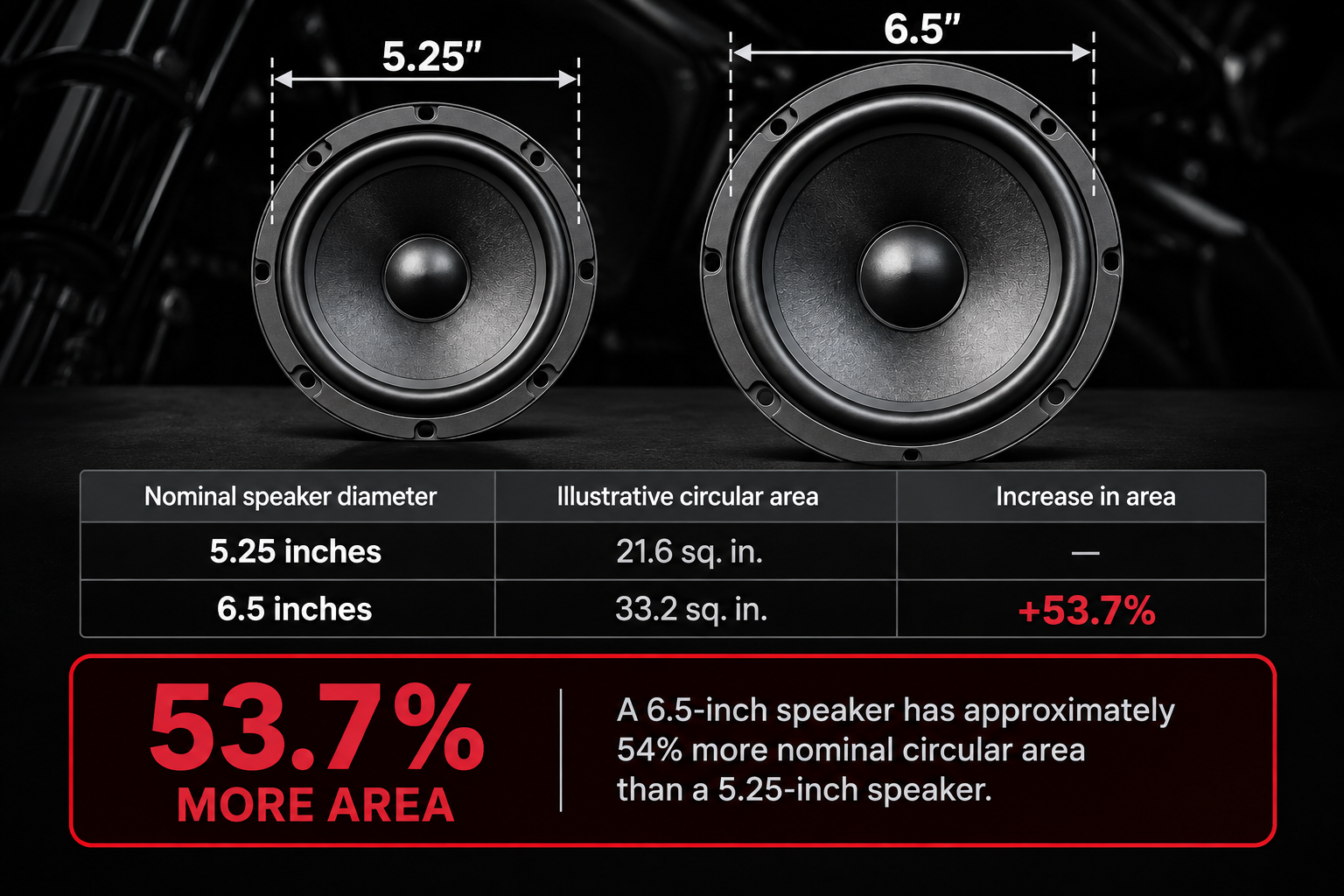
That additional area is particularly valuable when reproducing bass and midbass frequencies. For a given cone excursion, a larger diaphragm can displace more air. Conversely, to produce the same volume displacement, the larger speaker generally needs less cone movement.
That gives the designer more potential output without pushing the speaker as close to its mechanical limits. Of course, cone area is only part of the equation. Excursion, sensitivity, motor strength and amplifier power also determine how loudly and cleanly a speaker performs.
Now Remove the Fairing
Here's where things get interesting for Road King and Softail riders.
If owners of motorcycles with fairings routinely upgrade from 5.25-inch speakers to 6.5-inch speakers to improve their audio systems, why would you deliberately install 5.25" speakers on a motorcycle without a fairing?
| Speaker | Diameter | Sensitivity | RMS / speaker | Published frequency response |
|---|---|---|---|---|
| Aquatic AV HS113 Ultra+ RGB | 6.5" | Not published | 75 W | 60 Hz–20 kHz |
| Aquatic AV HS116 NEO | 6.5" | 96.5 dB | 120 W | 100 Hz–20 kHz |
| Hogtunes 352F-AA | 5.25" | 92 dB | 100 W | 55 Hz–25 kHz |
| Rockford Fosgate TMS5 | 5.25" | 90 dB | 65 W | 65 Hz–20 kHz |
| Kicker PS5250 | 5.25" | 88.3 dB | 50 W | 60 Hz–20 kHz |
Sources: Aquatic AV HS113 and HS116 product specifications; Hogtunes installation manual; Rockford Fosgate TMS5 manual; Kicker PS5250 specifications.
An unfaired motorcycle exposes the rider to greater direct airflow, so maximizing useful acoustic output becomes particularly important. At highway speeds, wind turbulence around the rider's helmet generates substantial broadband noise, while engine and exhaust noise compete with the music. The frequencies that give a kick drum its impact and a bass guitar its body can become increasingly difficult to distinguish.
Not all 6.5-inch speakers are created equal. Sensitivity, power handling, cone construction and motor design all influence how effectively a speaker converts amplifier power into sound—particularly at highway speeds, where wind, engine and exhaust noise compete with your music. That's why we chose Aquatic AV for our Havoc Roar systems. Both the HS113 Ultra+ RGB and HS116 NEO offer marine-grade construction and are designed for demanding outdoor environments, but we're particularly enthusiastic about the NEO. With a published sensitivity of 96.5 dB and 120 watts RMS power handling, it combines high sensitivity with substantial power capacity—exactly the characteristics we look for when designing a motorcycle audio system that needs to deliver clear, powerful sound without the protection of a fairing.
| Speaker | Sensitivity | RMS Power | Frequency Response |
|---|---|---|---|
| Aquatic AV HS116 NEO | 96.5 dB | 120 W | 100 Hz–20 kHz |
| Rockford Fosgate TMS65 | 94 dB | 75 W | 65 Hz–20 kHz |
| Hogtunes 362F-RM | 92 dB | 125 W | 55 Hz–25 kHz |
Note: Specifications are manufacturer-published and have not been independently verified. Sensitivity ratings may use different measurement standards and are not necessarily directly comparable. Aquatic AV does not specify the measurement reference for its HS116 sensitivity rating. Published frequency-response ranges may also use different tolerances. RMS power indicates rated power handling, not acoustic output or sound quality.
Speaker Enclosure Matters: Why the Havoc Roar Is More Than a Bigger Speaker
Simply bolting a larger speaker onto your highway bars isn't enough. The question isn't just whether a 6.5-inch speaker is bigger than a 5.25-inch speaker, or whether you've taken a speaker that looks impressive on paper and installed it in any old speaker pod. What matters is how the speaker and enclosure work together - and whether the entire motorcycle stereo system has been engineered to take advantage of the larger driver's capabilities.
The enclosure must provide the appropriate acoustic environment for the speaker. Its internal volume influences cone movement and low-frequency response, while its shape, construction and mounting determine how effectively it resists unwanted vibration.
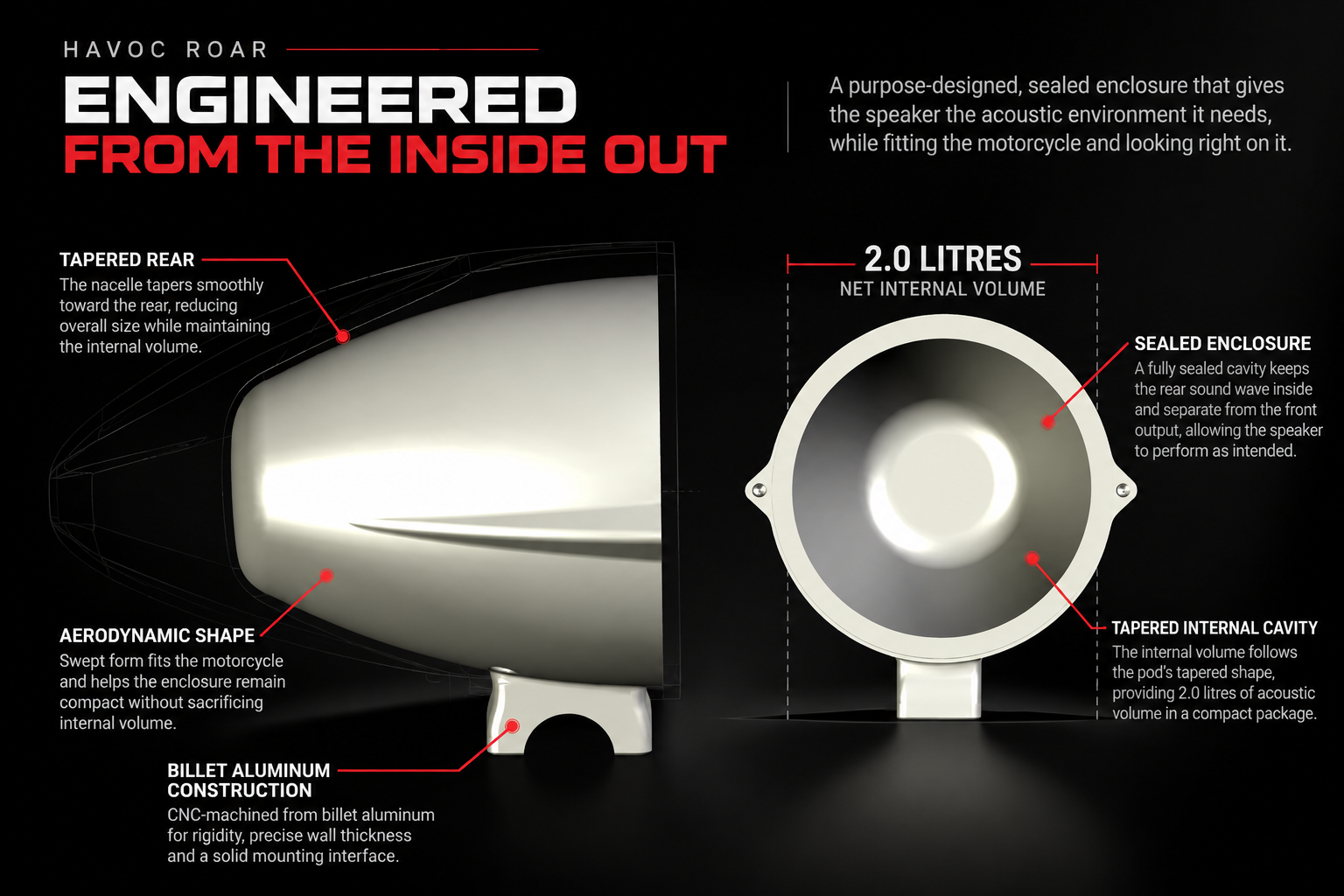
For the Havoc Roar, we've brought these elements together in a compact, 2.0-litre sealed aluminum enclosure designed to accommodate Aquatic AV's 6.5-inch speakers, including the high-sensitivity HS116 NEO.
Speaker Pod Volume: The Air Inside Is Part of the Suspension
Inside a sealed speaker pod, the air trapped behind the cone behaves like a spring. As the cone moves backward, it compresses that air; as it moves forward, the air expands. The speaker's spider and surround provide their own restoring force, while the enclosed air adds another.
The smaller the enclosure, the stiffer that trapped air becomes. A smaller enclosure therefore raises the speaker's installed resonant frequency and changes its low-frequency response and damping. A larger enclosure provides a softer air spring, generally lowering the system's resonance.
The relationship can be expressed using the standard sealed-box equation:
Fc = Fs √(1 + Vas / Vb)
Here, Fc is the speaker's resonance inside the enclosure, Fs is its free-air resonance, Vas represents its suspension compliance as an equivalent volume of air, and Vb is the enclosure's net internal acoustic volume.
Resonance alone, however, doesn't tell us which enclosure will sound best. A complete prediction also requires the driver's total damping factor (Qts) to calculate the installed system's damping (Qtc) and estimate its frequency response. And that's about as far as we're willing to take you behind the curtain. We believe riders deserve enough technical information to make an informed decision, so we're happy to explain the science, what matters and why. We'll even show you the math. But there's a difference between explaining loudspeaker engineering and handing our competitors the details of our enclosure design and system integration. Some things are staying right where they belong: in the Havoc workshop. For the next illustration, we'll use hypothetical driver parameters rather than pretend to have measurements Aquatic AV hasn't published. The 2.0-litre volume of our pod, however, is real.
How Enclosure Volume Changes Resonance
To illustrate the effect, consider a hypothetical 6.5-inch speaker with a free-air resonance of 72 Hz and an equivalent compliance volume of 5.8 litres.
| Sealed enclosure volume | Illustrative installed resonance |
|---|---|
| 1.0 litre | 188 Hz |
| 1.5 litres | 159 Hz |
| 2.0 litres — Havoc Roar | 142 Hz |
| 2.5 litres | 131 Hz |
| 3.5 litres | 117 Hz |
| 5.0 litres | 106 Hz |
Illustrative calculations using a hypothetical driver with Fs = 72 Hz and Vas = 5.8 litres. These are not verified specifications for the Aquatic AV HS116 NEO. The Havoc Roar's 2.0-litre enclosure volume is an actual design specification; the illustrated 142 Hz resonance is not a measured result for the Havoc Roar.
The model demonstrates that increasing enclosure volume lowers system resonance, but the benefit becomes progressively smaller as the enclosure grows.
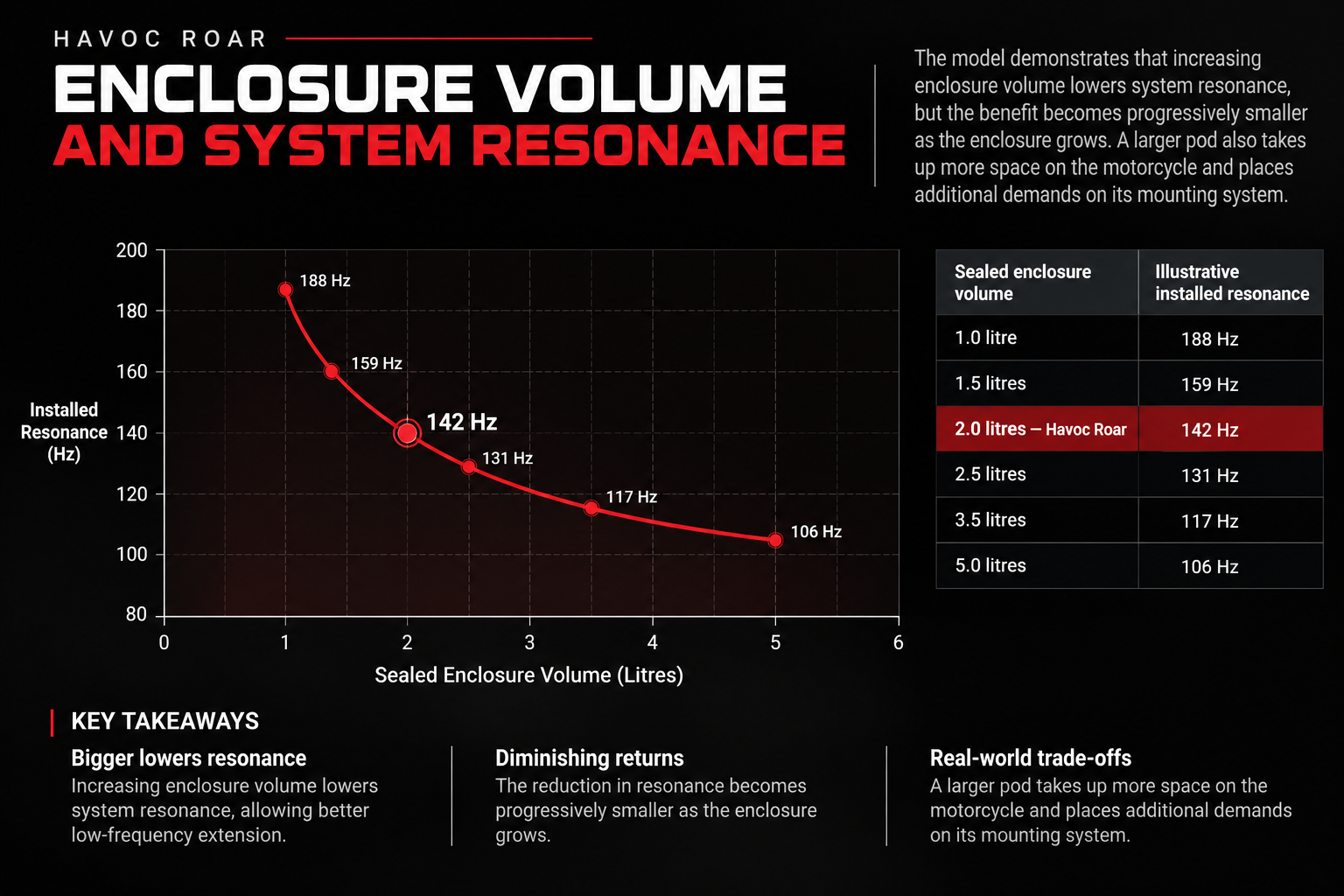
The objective isn't simply to build the largest enclosure possible. It's to choose a practical enclosure volume that supports the driver's intended operating range within the motorcycle's physical constraints.
Engineering for Punch at Highway Speed
A motorcycle stereo operates in an acoustic environment that changes constantly. Wind speed, helmet design, rider position, engine speed and exhaust noise all influence what the rider can hear.
There is no universal frequency below which bass simply disappears at highway speeds. Instead, the challenge is to produce sufficient clean output across the frequencies that remain audible to the rider without exhausting the speaker's mechanical excursion or the amplifier's available power.
This is particularly important on an unfaired Road King or Softail, where the rider is exposed to direct airflow rather than sitting behind a large touring fairing.
The Aquatic AV HS116 NEO offers several characteristics that make it attractive for this application. It is a 6.5-inch marine-grade coaxial speaker with a published sensitivity of 96.5 dB, 120 watts RMS power handling per speaker, a 38 mm woofer voice coil and a neodymium motor. Its stated frequency-response range is 100 Hz–20 kHz.
High sensitivity is particularly useful in a motorcycle stereo because it indicates the potential to produce substantial acoustic output from a given electrical input. The manufacturer's sensitivity measurement reference isn't specified, so its published figure shouldn't be treated as a directly comparable laboratory measurement against every competing speaker.
But even a capable driver cannot perform independently of its enclosure and amplifier.
Enclosure volume and system damping influence the speaker's response. Appropriate equalization and high-pass filtering help manage cone excursion, reduce unnecessary low-frequency demands and protect the driver. The amplifier must also supply sufficient clean power without introducing excessive distortion.
The goal is convincing midbass impact, vocal clarity and dynamic headroom on the road—not simply an impressive wattage claim in a parking lot.
Why We Use a 2.0-Litre Sealed Enclosure
The Havoc Roar's 2.0-litre enclosure balances acoustic volume with the packaging requirements of a highway-bar-mounted motorcycle stereo.
A sealed cavity provides a controlled air spring behind the driver and separates the rear sound wave from the sound radiated forward. This separation is essential: if the opposing sound waves mix through gaps around the speaker or enclosure, they can partially cancel one another, particularly at lower frequencies.
The enclosure's volume also influences the speaker's installed resonance and damping. These characteristics must be considered alongside the amplifier's output and filtering.
Why Pod Shape and Construction Matter
The Havoc Roar's swept nacelle form is designed around the motorcycle's available mounting space, speaker geometry and internal cavity. Its curved and tapered surfaces also avoid some of the broad, flat panels found in boxier speaker enclosures.
Shape matters because pressure fluctuations inside a sealed pod exert force on its walls. If those walls flex or vibrate significantly, some of the energy intended to produce sound can instead excite the enclosure.
Curvature, wall thickness and structural geometry can improve stiffness and help resist unwanted panel movement. The actual vibration behaviour of any enclosure, however, depends on its complete design, material, mounting and operating frequency.
Havoc uses CNC-machined aluminum to produce a compact, rigid housing with precise, repeatable geometry and a solid mounting interface. This construction allows the speaker, baffle, enclosure walls and mounting system to be designed together.
Aluminum doesn't eliminate resonance, and it isn't inherently better damped than every plastic. A well-designed reinforced polymer enclosure can perform very well. Conversely, a thin, flexible plastic housing with inadequate mounting or sealing may vibrate, rattle or radiate unwanted sound. The meaningful comparison is between complete enclosure designs—not simply aluminum versus plastic.
This distinction is especially relevant when comparing a dedicated sealed speaker pod with a speaker installed in a motorcycle's lower fairing. A lower fairing with an irregular internal cavity, large unsupported panels or a leaky speaker mounting surface may require additional sealing, reinforcement or vibration damping.
A purpose-designed sealed pod allows its internal volume, baffle, wall geometry and mounting structure to be developed as one assembly.
And Now You Know the Rest of the Story
We've covered speaker diameter, cone area, sensitivity, amplifier power, enclosure volume and even the mathematics of resonance. But here's the thing: you don't need to understand every equation to appreciate what all that engineering is supposed to accomplish.
Consider what Harley owners have been doing for years. They take a motorcycle with a fairing, replace its 5.25-inch speakers with 6.5-inch speakers in pursuit of better sound, and install acoustic treatments to help them perform." Yet when it comes to a Road King or Softail, where the rider is exposed to even more wind and environmental noise, we're somehow expected to believe that 5.25" speakers in a couple of generic pods made of plastic or drawn metal without consideration of internal volume or speaker spring are good enough.
We don't think so – and if you've persevered through the preceding 10 pages (!) you likely don't either.
We've shared the principles behind our design because we believe riders should understand what they're buying. We haven't shared every dimension, calculation or engineering detail. Some things took us considerable time and effort to develop, and we'd rather our competitors did their own homework.
Ultimately, the real test isn't a specification sheet, a wattage claim or how impressive a stereo sounds while the motorcycle is sitting in the driveway. It's what happens when you roll onto the highway, settle into sixth gear and turn up your favourite song.
Because at 70 miles an hour, nobody cares how many watts are printed on the box.
They care whether they can still hear the music.
Frequently Asked Questions
Are 6.5-inch motorcycle speakers better than 5.25-inch speakers?
They offer more potential radiating area, but real performance depends on the driver's effective cone area, excursion, sensitivity, enclosure and amplifier. Compare complete systems rather than diameter alone.
Does a larger motorcycle speaker pod produce more bass?
Not necessarily. More sealed volume generally lowers system resonance for the same driver, but the best response depends on the driver's Thiele/Small parameters, desired damping and available excursion.
Are billet aluminum speaker pods better than plastic lower fairings?
Billet aluminum can provide high rigidity and precise compact geometry. A well-engineered plastic enclosure can also perform well. The relevant differences are enclosure design, sealing, panel vibration, mounting and measured output.
Does acoustic foam increase bass?
Sealing gaskets can reduce front-to-rear cancellation; damping sheets reduce panel vibration; and suitable stuffing can alter effective sealed-box compliance. Ordinary thin foam does not itself create deep bass.